
Online Database of Chemicals from Around the World
| Shanghai T&W Pharmatech Co., Ltd. | China | |||
|---|---|---|---|---|
 | www.trustwe.com | |||
 | +86 (21) 6155-1611 6155-1413 6155-1420 | |||
 | +86 (21) 5067-6805 | |||
 | contact@trustwe.com | |||
| Chemical manufacturer since 2007 | ||||
| chemBlink Standard supplier since 2008 | ||||
| Abian Darou-Golrang | Iran | |||
|---|---|---|---|---|
| www.golrangpi.com | |||
| +98 (21) 2485-2693 | |||
| +98 (21) 8877-7511 | |||
| v.khani@golrangpi.com | |||
| Chemical manufacturer since 2018 | ||||
| chemBlink Standard supplier since 2020 | ||||
| Nutrition BioTech USA Inc. | USA | |||
|---|---|---|---|---|
| www.naturalbestbio.com | |||
| +1 (909) 745-1357 | |||
| sales@naturalbestbio.com | |||
| Chemical manufacturer since 2024 | ||||
| chemBlink Standard supplier since 2026 | ||||
| Classification | API >> Water, electrolyte and acid-base balance regulator >> Glucose drug |
|---|---|
| Name | Levomefolic acid compd. with 2-amino-2-deoxy-D-glucose (1:2) |
| Synonyms | (2S)-2-[[4-[[(6S)-2-amino-5-methyl-4-oxo-3,6,7,8-tetrahydropteridin-6-yl]methylamino]benzoyl]amino]pentanedioic acid;bis((2R,3R,4S,5R)-2-amino-3,4,5,6-tetrahydroxyhexanal) |
| Molecular Structure | 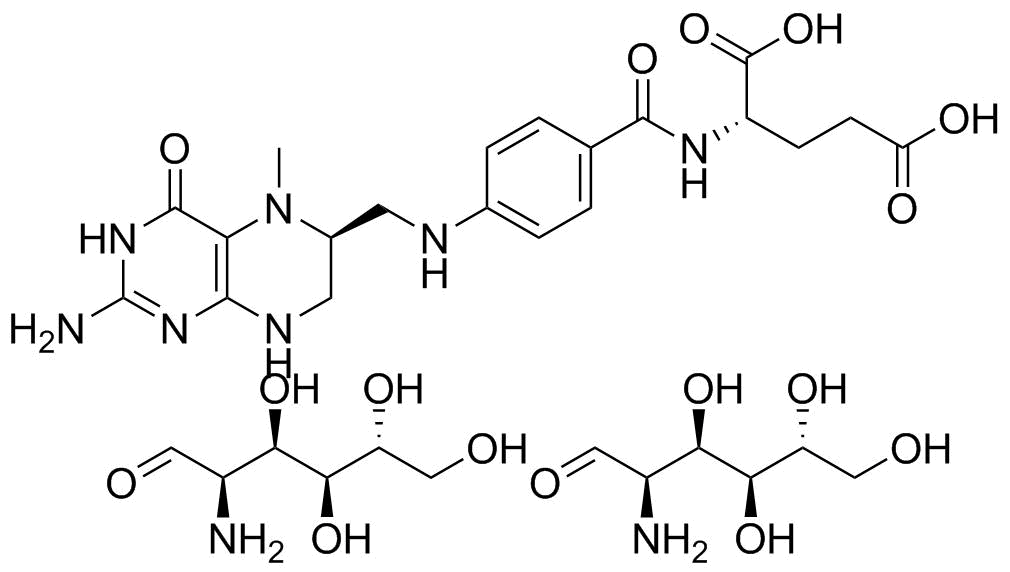 |
| Molecular Formula | C20H25N7O6.2(C6H13NO5) |
| Molecular Weight | 817.81 |
| CAS Registry Number | 1181972-37-1 |
| SMILES | CN1[C@H](CNC2=C1C(=O)NC(=N2)N)CNC3=CC=C(C=C3)C(=O)N[C@@H](CCC(=O)O)C(=O)O.C([C@H]([C@H]([C@@H]([C@H](C=O)N)O)O)O)O.C([C@H]([C@H]([C@@H]([C@H](C=O)N)O)O)O)O |
| Hazard Symbols |  GHS07 Warning Details |
|---|---|
| Risk Statements | H302-H315-H319 Details |
| Safety Statements | P501-P270-P264-P280-P302+P352-P337+P313-P305+P351+P338-P362+P364-P332+P313-P301+P312+P330 Details |
| SDS | Available |
 chemBlink Chemical Story
|
Levomefolate glucosamine pairs one molecule of (6S)-5-methyltetrahydrofolic acid with two equivalents of D-glucosamine. The systematic ingredient name, which calls the sugar 2-amino-2-deoxy-D-glucose, explains how the two partners fit together chemically. Glucosamine has an amino group where glucose has a hydroxyl group at position 2. That amino group can accept a proton, while the glutamate part of the folate provides two acidic carboxyl groups. The result is a salt rather than a folate molecule with sugars covalently grafted onto it. The (6S) descriptor identifies the configuration at a center in the reduced pteridine portion of the folate. The compound also contains the L-glutamate portion common to this family. Neither detail is conveyed by the expression vitamin B9. That term covers multiple folate forms, including folic acid, which has a different oxidation state and does not already carry the same methyl group. Folate chemistry is concerned with the movement of one-carbon units; 5-methyltetrahydrofolate supplies a methyl group in the vitamin B12-dependent reaction that regenerates methionine from homocysteine. This biochemical role belongs to the folate moiety rather than the glucosamine counterion. The ingredient can be traced through a particularly clear regulatory paper trail. In 2013, the European Food Safety Authority evaluated the glucosamine salt as a folate source for food supplements, considering the substance specification and whether folate from the ingredient was bioavailable. The European Commission's subsequent specification lists the registry number and the anhydrous formula C32H51N9O16, with a molar mass of 817.80 g/mol. Adding the formulas of one free folate acid and two glucosamine molecules gives that overall composition; transfer of protons in a salt changes the charges without changing the atom total. The distinction is particularly useful when a study compares different sources of folate. A chemically defined amount of the glucosamine salt and the same mass of folic acid do not constitute the same amount of folate material. The counterions contribute to the mass, and the two folate forms differ chemically. A comparison can instead specify the amount of folate administered and then define how its appearance in circulation is measured. Such a design separates chemical accounting from the biological question. Even then, a measure of circulating folate under the conditions of a study should not be read as proof of an effect on every clinical outcome for which folate might be relevant. The comparison reviewed by EFSA was a crossover study in volunteers: it evaluated the glucosamine salt against calcium 5-methyltetrahydrofolate rather than treating their different names as proof of different nutrient delivery. The panel concluded that folate from the two sources showed similar bioavailability in that study. It also expected the glucosamine salt to dissociate under aqueous conditions in the digestive tract. The result helps explain why changing a mineral counterion to a sugar-derived counterion does not necessarily change the identity of the folate presented for absorption. The regulatory assessment was about the proposed food supplement ingredient and its conditions of use, a narrower question than choosing a folate form for any individual. An ingredient name and a nutrient declaration answer different questions. The registry entry identifies the material, including its partner ions, while an assessment of folate supply is concerned with the folate portion. Evidence about a specified glucosamine salt should likewise not be read as a general statement about every formulation marketed as methylfolate. This distinction is useful in reading technical specifications, study designs and labels together. References: 1. EFSA ANS Panel. Scientific opinion on (6S)-5-MTHF glucosamine salt. EFSA Journal 2013;11:3358. https://doi.org/10.2903/j.efsa.2013.3358 2. European Commission. Implementing Decision 2014/154/EU, specifications. https://eur-lex.europa.eu/eli/dec_impl/2014/154/oj 3. FDA GSRS, levomefolate glucosamine. https://precision.fda.gov/uniisearch/srs/unii/Q65PL71Q1A |
| Market Analysis Reports |