
Online Database of Chemicals from Around the World
| Yujiao Bio-chem Co., Ltd. | China | |||
|---|---|---|---|---|
 | yujiaobiochem.com | |||
 | +86 17060324263 | |||
 | ficherchem@gmail.com | |||
| Chemical distributor since 2016 | ||||
| chemBlink Standard supplier since 2023 | ||||
| Pharmaccare | UK | |||
|---|---|---|---|---|
| www.pharmaccare.com | |||
| +44 7362050789 | |||
| duranjohnson16@gmail.com | |||
| Chemical distributor since 2020 | ||||
| chemBlink Standard supplier since 2026 | ||||
| Classification | Organic raw materials >> Carboxylic compounds and derivatives >> Carboxylic esters and their derivatives |
|---|---|
| Name | Methyl 10-(2,5-dioxo-2,5-dihydro-1H-pyrrol-1-yl)-9-methoxy-3-oxo-3H-benzo[f]chromene-2-carboxylate |
| Molecular Structure | 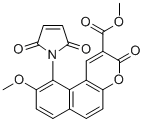 |
| Molecular Formula | C20H13NO7 |
| Molecular Weight | 379.32 |
| CAS Registry Number | 137350-66-4 |
| SMILES | COC1=C(C2=C(C=CC3=C2C=C(C(=O)O3)C(=O)OC)C=C1)N4C(=O)C=CC4=O |
| Solubility | 658.7 mg/L (25 °C water) |
|---|---|
| Density | 1.5±0.1 g/cm3, Calc.* |
| Index of Refraction | 1.682, Calc.* |
| Melting point | 278.78 °C |
| Boiling Point | 641.68 °C, 635.5±55.0 °C (760 mmHg), Calc.* |
| Flash Point | 338.1±31.5 °C, Calc.* |
| * | Calculated using Advanced Chemistry Development (ACD/Labs) Software. |
| Hazard Symbols |  GHS07 Warning Details |
|---|---|
| Risk Statements | H302-H315-H319-H332-H335 Details |
| Safety Statements | P361-P280-P305+P351+P338 Details |
| SDS | Available |
 chemBlink Chemical Story
|
Behind the long systematic name of CAS 137350-66-4 is ThioGlo 1, a fluorogenic reagent for detecting thiol groups. Its structure brings together a maleimide reaction site and a fluorescent molecular framework. The analytical idea is to convert a chemical event into a stronger optical signal: reaction with an accessible thiol produces an adduct whose fluorescence is much greater than that of the unreacted reagent. A thiol is a sulfur-containing group found in compounds such as reduced glutathione and in cysteine residues of proteins. Measuring these groups can help researchers investigate redox chemistry or characterize a sample. ThioGlo 1 participates in the measurement by chemically labeling the groups. It is not itself glutathione, an antioxidant supplement, or a biological repair agent. Its usefulness lies in making otherwise less visible chemistry easier to detect. In a 2010 Analytical Chemistry paper, Wu and colleagues integrated ThioGlo 1 labeling with separation and fluorescence detection of reduced glutathione. Their work demonstrated how derivatization could be incorporated into an analytical device rather than treated only as an isolated preparation step. It is an example of matching the speed of a chemical reaction to the demands of measurement. A different application highlighted the need for separation. A 2013 Analyst study measured soluble protein-derived thiols in beer using ThioGlo 1 derivatives. Fluorescent products arising from sulfite could interfere, so chromatography was used to distinguish them. A bright signal alone was therefore insufficient to identify the intended analyte. The chemical composition of the signal mattered as much as its intensity. This distinction extends to glutathione measurements. Thiol reactivity is a form of group selectivity, not automatic recognition of one uniquely named molecule. Other accessible thiols in a mixture can also consume reagent or contribute fluorescence. Sample handling, suitable standards, background correction, and separation where needed determine how confidently the result can be interpreted. ThioGlo 1 thus tells a broader story about chemical sensors. A useful label must have both a reaction that addresses the target chemistry and a readout that can be interpreted in the actual sample. The reagent supplies the conversion from thiol chemistry to light; the analytical method supplies the evidence connecting that light to a particular measurement. References: 1. Merck. ThioGlo 1 Fluorescent Thiol Reagent, product 595501; CAS 137350-66-4. https://www.merckmillipore.com/INTL/en/product/ThioGlo-1-Fluorescent-Thiol-Reagent,EMD_BIO-595501 2. Wu J et al. Integration of a precolumn fluorogenic reaction, separation, and detection of reduced glutathione. Anal Chem. 2010;82:7267-7273. https://doi.org/10.1021/ac101182r 3. Quantification of protein thiols using ThioGlo 1 fluorescent derivatives and HPLC separation. Analyst. 2013. https://doi.org/10.1039/C3AN36672C |
| Market Analysis Reports |