
Online Database of Chemicals from Around the World
| Simagchem Corporation | China | |||
|---|---|---|---|---|
 | www.simagchem.com | |||
 | +86 13806087780 | |||
 | +86 (592) 268-0237 | |||
 | sale@simagchem.com | |||
| Chemical manufacturer since 2002 | ||||
| chemBlink Standard supplier since 2008 | ||||
| Hubei Widely Chemical Technology Co., Ltd. | China | |||
|---|---|---|---|---|
| www.widelychemical.com | |||
| +86 (27) 8398-9310 | |||
| +86 (27) 8398-9310 | |||
| hector@widelychemical.com | |||
| Chemical manufacturer since 2012 | ||||
| chemBlink Standard supplier since 2013 | ||||
| NetQem, LLC | USA | |||
|---|---|---|---|---|
| www.netqem.us | |||
| +1 (919) 544-4122 | |||
| +1 (919) 544-4109 | |||
| sales@netqem.us | |||
| Chemical distributor since 2013 | ||||
| chemBlink Standard supplier since 2014 | ||||
| Zley Holdings (Suzhou) Co., Ltd. | China | |||
|---|---|---|---|---|
| www.zleygroup.com | |||
| +86 (0512) 8777-5990 +86 18626205929 | |||
| +86 (0512) 8777-5990 | |||
| huangzhenzhou@zleygroup.com | |||
 | WhatsApp:+852-9061-4262 | |||
| Chemical manufacturer since 2019 | ||||
| chemBlink Standard supplier since 2026 | ||||
| AK Scientific, Inc | USA | |||
|---|---|---|---|---|
| www.aksci.com | |||
| +1 (510) 429-8835 | |||
| +1 (510) 429-8836 | |||
| sales@aksci.com | |||
| Chemical manufacturer | ||||
| Classification | API >> Urinary system medication >> Other urinary system medication |
|---|---|
| Name | Piperazine ferulate |
| Synonyms | Piperazine 3-methoxy-4-hydroxycinnamate |
| Molecular Structure | 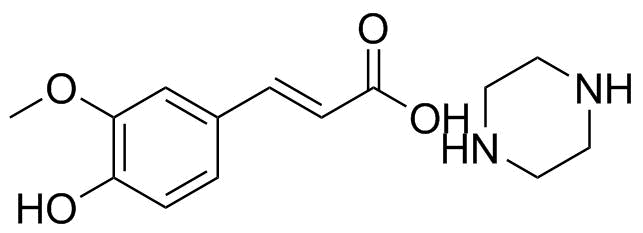 |
| Molecular Formula | C10H10O4.C4H10N2 |
| Molecular Weight | 280.32 |
| CAS Registry Number | 171876-65-6 |
| EC Number | 805-535-0 |
| SMILES | COC1=C(C=CC(=C1)/C=C/C(=O)O)O.C1CNCCN1 |
| Hazard Symbols |  GHS07 Warning Details GHS07 Warning Details | ||||||||
|---|---|---|---|---|---|---|---|---|---|
| Risk Statements | H302-H315-H319-H335 Details | ||||||||
| Safety Statements | P261-P280-P301+P312-P302+P352-P305+P351+P338 Details | ||||||||
| Hazard Classification | |||||||||
| |||||||||
| SDS | Available | ||||||||
 chemBlink Chemical Story
|
Piperazine ferulate, CAS 171876-65-6, is a 1:1 compound of piperazine and ferulic acid. Its molecular formula is C14H20N2O4 and its molecular weight is 280.32. Structurally, it combines the phenolic cinnamic-acid framework of ferulic acid with the basic six-membered diamine piperazine. This pairing is important because it transforms a naturally occurring phenolic acid into a salt form with different physicochemical and pharmaceutical properties. Commercial chemical records identify the compound as piperazine (E)-3-(4-hydroxy-3-methoxyphenyl)acrylate. Ferulic acid is widely distributed in plants, where it occurs particularly in cell walls and cereal grains, often bound to polysaccharides and lignin-related structures. Chemically, it contains a substituted aromatic ring with one hydroxyl group, one methoxy group, and an unsaturated carboxylic acid side chain. This arrangement places ferulic acid within the hydroxycinnamic acid family and contributes to its well-known redox chemistry. Piperazine provides a very different type of structure. It is a saturated six-membered heterocycle containing two nitrogen atoms opposite one another in the ring. Because these nitrogens are basic, piperazine can form salts with acidic compounds. Combining piperazine with ferulic acid therefore produces piperazine ferulate, in which acid-base chemistry converts the neutral carboxylic acid into a ferulate salt associated with protonated piperazine. Salt formation is a familiar strategy in pharmaceutical chemistry. A biologically interesting molecule may have useful pharmacological properties but inconvenient solubility, crystallinity, stability, or formulation behavior. Converting an acidic or basic compound into an appropriate salt can change these properties without altering the main covalent framework responsible for biological activity. Piperazine ferulate is an example of this broader principle. The compound has acquired particular importance in China, where piperazine ferulate preparations have been used clinically in the treatment of chronic kidney diseases. Published biomedical literature describes its use in chronic nephritis, nephrotic syndrome, and diabetic nephropathy, frequently in combination with established renin-angiotensin system therapies such as angiotensin-converting enzyme inhibitors or angiotensin receptor blockers. These uses have stimulated substantial research into its possible renal protective mechanisms. One major research area is diabetic nephropathy. Diabetes can progressively damage glomeruli, the specialized filtration structures of the kidney. Hyperglycemia promotes oxidative stress, inflammation, endothelial dysfunction, extracellular-matrix accumulation, and podocyte injury. Several experimental studies have reported that piperazine ferulate can attenuate these processes in cell and animal models. A 2019 study examined streptozotocin-induced diabetic nephropathy in rats and reported that piperazine ferulate improved several renal and biochemical parameters. The investigators linked these effects in part to restoration of the nitric oxide synthase/nitric oxide system and reduction of oxidative stress. These findings supported the idea that the compound may influence vascular and redox pathways relevant to diabetic kidney injury. Subsequent studies expanded the mechanistic picture. In cultured renal cells exposed to high glucose, piperazine ferulate has been reported to reduce oxidative stress, apoptosis, and inflammatory signaling. More recent work has examined pathways involving advanced glycation end products and their receptor RAGE, as well as downstream inflammatory responses. Other studies have investigated effects on podocyte injury, extracellular-matrix deposition, and fibrosis. These mechanistic studies are important but should be interpreted carefully. Much of the detailed molecular evidence comes from animal and cell models rather than large randomized clinical trials. The compound's use in China provides real clinical context, but experimental findings about individual signaling pathways should not automatically be treated as definitive explanations of its effects in patients. Piperazine ferulate is also an interesting example of how the identity of a pharmaceutical substance can lie between natural-product chemistry and synthetic formulation chemistry. Ferulic acid itself originates from a chemical motif abundant in plants. Piperazine, in contrast, is a simple synthetic heterocycle. Joining the two by salt formation does not create a completely new covalent skeleton, but it produces a distinct pharmaceutical substance with its own solid-state, formulation, and biological behavior. This distinction is particularly important when discussing pharmacology. Piperazine ferulate should not simply be treated as interchangeable with ferulic acid. The two compounds differ in ionic form, molecular composition, and potentially in absorption, distribution, and formulation behavior. Likewise, the presence of piperazine does not imply the pharmacology associated with unrelated piperazine-containing drugs. The properties of the complete compound must be evaluated as a whole. The development of piperazine ferulate also illustrates a broader theme in medicinal chemistry: innovation does not always require inventing a completely new molecular scaffold. Sometimes a known biologically active molecule can acquire new practical value when converted into an appropriate salt, prodrug, formulation, or delivery form. These changes can influence whether the chemistry is usable in medicine even when the central pharmacophore remains familiar. Piperazine ferulate therefore connects several areas of chemistry. It begins with ferulic acid, a plant-derived hydroxycinnamic acid; uses basic piperazine to create a pharmaceutical salt; and has become the subject of renal pharmacology, oxidative-stress research, and fibrosis studies. Its story shows how a relatively simple acid-base transformation can move a molecule from natural-product chemistry into a distinct pharmaceutical context. References 1. Yang, Y. Y. et al. (2019). "Piperazine ferulate ameliorates the development of diabetic nephropathy by regulating endothelial nitric oxide synthase." Molecular Medicine Reports, 19, 2245-2254. https://pubmed.ncbi.nlm.nih.gov/30664213/ 2. Yang, Y. Y. et al. (2021). "Piperazine ferulate attenuates high glucose-induced mesangial cell injury via modulation of oxidative stress and inflammatory signaling." Experimental study of diabetic nephropathy-related mechanisms. 3. Zhang, X. M. et al. (2024). "Piperazine ferulate inhibits diabetic nephropathy by suppressing AGE/RAGE-mediated inflammatory signaling in rats and podocytes." Frontiers in Pharmacology, 15, 1394369. https://doi.org/10.3389/fphar.2024.1394369 4. LGC Standards. Piperazine Ferulate, CAS 171876-65-6. Chemical identity: piperazine (E)-3-(4-hydroxy-3-methoxyphenyl)acrylate. 5. Sigma-Aldrich / AA Blocks. Piperazine Ferulate, CAS 171876-65-6. Molecular formula C14H20N2O4; molecular weight 280.32. |
| Market Analysis Reports |