
Online Database of Chemicals from Around the World
| Biocompounds Pharmaceutical Inc. | China | |||
|---|---|---|---|---|
 | www.biocompounds.com | |||
 | +86 (21) 5768-7675 | |||
 | +86 (21) 5768-7169 | |||
 | sales@biocompounds.com info@biocompounds.com | |||
 | QQ Chat | |||
| Chemical manufacturer since 2003 | ||||
| chemBlink Standard supplier since 2007 | ||||
| CEC Chemical Co., Ltd. | China | |||
|---|---|---|---|---|
| www.cecchem.com | |||
| +86 (21) 5241-8058 | |||
| +86 (21) 5241-1245 | |||
| eric@cecchem.com | |||
| Chemical manufacturer | ||||
| chemBlink Standard supplier since 2008 | ||||
| Simagchem Corporation | China | |||
|---|---|---|---|---|
| www.simagchem.com | |||
| +86 13806087780 | |||
| +86 (592) 268-0237 | |||
| sale@simagchem.com | |||
| Chemical manufacturer since 2002 | ||||
| chemBlink Standard supplier since 2008 | ||||
| HBCChem, Inc. | USA | |||
|---|---|---|---|---|
| www.hbcchem-inc.com | |||
| +1 (510) 219-6317 | |||
| +1 (510) 675-0318 | |||
| sales@hbcchem-inc.com | |||
| Chemical manufacturer | ||||
| chemBlink Standard supplier since 2008 | ||||
| Zhejiang Qiming Pharmaceutical Co., Ltd. | China | |||
|---|---|---|---|---|
| www.qimingpharm.com | |||
| +86 (571) 8716-3895 8716-3893 | |||
| +86 (571) 8716-3816 | |||
| sales@qimingpharm.com | |||
| QQ Chat | |||
| Chemical manufacturer | ||||
| chemBlink Standard supplier since 2009 | ||||
| Minakem S.A.S. | France | |||
|---|---|---|---|---|
| www.minakem.com | |||
| +33 (3) 2064-6830 | |||
| +33 (3) 2064-3198 | |||
| contact@minakem.com | |||
| Chemical manufacturer | ||||
| chemBlink Standard supplier since 2009 | ||||
| Changzhou Hi-Tech Chemistry Corp | China | |||
|---|---|---|---|---|
| www.eastfine.net | |||
| +86 (519) 8662-7600 | |||
| +86 (519) 8662-9716 | |||
| sales@watsonchem.com | |||
| Chemical manufacturer | ||||
| chemBlink Standard supplier since 2009 | ||||
| BOC Sciences | USA | |||
|---|---|---|---|---|
| www.bocsci.com | |||
| +1 (631) 485-4226 | |||
| +1 (631) 614-7828 | |||
| info@bocsci.com | |||
| Chemical manufacturer | ||||
| chemBlink Standard supplier since 2010 | ||||
| Hangzhou Leap Chem Co., Ltd. | China | |||
|---|---|---|---|---|
| www.leapchem.com | |||
| +86 (571) 8771-1850 | |||
| market19@leapchem.com | |||
| QQ Chat | |||
| Chemical manufacturer since 2006 | ||||
| chemBlink Standard supplier since 2015 | ||||
| Coresyn Pharmatech Co., Ltd. | China | |||
|---|---|---|---|---|
| www.coresyn.com | |||
| +86 (571) 8662-6709 | |||
| sales@coresyn.com | |||
| Chemical manufacturer | ||||
| chemBlink Standard supplier since 2016 | ||||
| Zhejiang Zetian Fine Chemicals Co., Ltd. | China | |||
|---|---|---|---|---|
| www.zetchem.com | |||
| +86 (571) 8732-2520 | |||
| sales@zetchem.com | |||
| Chemical manufacturer since 2009 | ||||
| chemBlink Standard supplier since 2018 | ||||
| Volant Technology Co., Ltd. | China | |||
|---|---|---|---|---|
| www.volantchemical.com | |||
| +86 19157790159 13456731436 | |||
| +86 (571) 8163-4339 | |||
| sales@volantgroup.com | |||
| QQ Chat | |||
| Chemical manufacturer since 2007 | ||||
| chemBlink Standard supplier since 2023 | ||||
| INA Pharmaceuticals Pvt. Ltd. | India | |||
|---|---|---|---|---|
| inapharma.in | |||
| +91 7815933367 | |||
| rd@inapharma.in | |||
| Chemical manufacturer since 2018 | ||||
| chemBlink Standard supplier since 2026 | ||||
| Classification | Organic raw materials >> Hydrocarbon compounds and their derivatives >> Cyclic hydrocarbon |
|---|---|
| Name | (Bromomethyl)cyclobutane |
| Synonyms | Cyclobutylmethyl bromide |
| Molecular Structure | 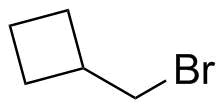 |
| Molecular Formula | C5H9Br |
| Molecular Weight | 149.03 |
| CAS Registry Number | 17247-58-4 |
| EC Number | 700-027-4 |
| SMILES | C1CC(C1)CBr |
| Density | 1.4±0.1 g/cm3 Calc.*, 1.353 g/mL (Expl.) |
|---|---|
| Boiling point | 124.0±8.0 °C 760 mmHg (Calc.)*, 123 - 124 °C (Expl.) |
| Flash point | 43.9±13.6 °C (Calc.)*, 36 °C (Expl.) |
| Index of refraction | 1.499 (Calc.)*, 1.48 (Expl.) |
| * | Calculated using Advanced Chemistry Development (ACD/Labs) Software. |
| Hazard Symbols |   GHS02;GHS07 WarningGHS02; Details GHS02;GHS07 WarningGHS02; Details | ||||||||||||||||||||
|---|---|---|---|---|---|---|---|---|---|---|---|---|---|---|---|---|---|---|---|---|---|
| Risk Statements | H226-H315-H319-H335 Details | ||||||||||||||||||||
| Safety Statements | P210-P233-P240-P241-P242-P243-P261-P264-P264+P265-P271-P280-P302+P352-P303+P361+P353-P304+P340-P305+P351+P338-P319-P321-P332+P317-P337+P317-P362+P364-P370+P378-P403+P233-P403+P235-P405-P501 Details | ||||||||||||||||||||
| Hazard Classification | |||||||||||||||||||||
| |||||||||||||||||||||
| Transport Information | UN 1993 | ||||||||||||||||||||
| SDS | Available | ||||||||||||||||||||
 chemBlink Chemical Story
|
(Bromomethyl)cyclobutane, CAS 17247-58-4, is a small organobromine compound used primarily as a synthetic building block in organic and medicinal chemistry. It is also known as cyclobutylmethyl bromide and has the molecular formula C5H9Br and a molecular weight of 149.03. Its structure combines a four-membered cyclobutane ring with a bromomethyl group, giving chemists a convenient way to introduce a compact cyclobutylmethyl fragment into larger molecules. :contentReference[oaicite:0]{index=0} The bromine atom is attached to a primary carbon outside the ring rather than directly to the cyclobutane itself. This matters because the carbon-bromine bond can serve as a useful leaving-group site in nucleophilic substitution reactions. Nitrogen-, oxygen-, sulfur-, and carbon-centered nucleophiles can replace bromide under appropriate conditions, allowing the cyclobutylmethyl group to be transferred onto many different molecular frameworks. This kind of reaction makes cyclobutylmethyl bromide particularly useful in medicinal chemistry. A chemist may already have a complex amine, phenol, thiol, or other nucleophile and want to test what happens when a cyclobutylmethyl group is attached. Rather than rebuilding the whole molecule from the beginning, the bromide acts as a compact alkylating reagent that installs this group in a comparatively direct step. Why use cyclobutylmethyl at all? One reason is molecular shape. Cyclobutane is a small, strained ring that occupies three-dimensional space differently from a simple straight or branched alkyl chain. Replacing a flexible substituent with a cyclobutyl-containing group can change conformational freedom, hydrophobic surface, steric interactions, and metabolic behavior. In drug discovery, these effects are often explored systematically through structure-activity relationship studies. Published synthetic chemistry provides several concrete examples. Commercial and literature sources describe the use of (bromomethyl)cyclobutane in the synthesis of racemic 3-cyclobutylalanine. In this case, the bromomethyl compound provides the cyclobutylmethyl carbon skeleton needed to construct an unnatural amino acid. Such amino acids are valuable research tools because changing the side chain of a familiar amino-acid framework can alter the properties of peptides and other biologically active molecules. :contentReference[oaicite:1]{index=1} Another documented application connects the reagent with morphinan chemistry. (Bromomethyl)cyclobutane has been used in the preparation of 17-(cyclobutylmethyl)morphinan-3-ol, also known as butorphan in some literature and closely related to the opioid antagonist/agonist morphinan family. In this transformation, the cyclobutylmethyl group is introduced onto nitrogen through alkylation chemistry. The building block itself is not an opioid drug; its role is to provide one specific substituent within a far more complex molecular structure. :contentReference[oaicite:2]{index=2} This example illustrates an important theme in medicinal chemistry: changing only one substituent can strongly alter biological behavior. In opioid chemistry, N-substitution on the morphinan nitrogen has long been known to influence receptor activity and pharmacological profile. Small alkyl groups, allyl groups, cyclopropylmethyl groups, cyclobutylmethyl groups, and related substituents can produce substantially different effects even though the rest of the molecular framework remains largely unchanged. (Bromomethyl)cyclobutane is therefore useful not because it has a complex molecular structure, but because it delivers a structurally distinctive group in a controllable way. The cyclobutane ring introduces compact three-dimensional shape, while the bromomethyl carbon acts as the point at which that shape can be attached to another molecule. The compound also highlights the relationship between ring strain and practical chemical stability. Cyclobutane contains significant ring strain because its carbon atoms are forced into bond angles far from the preferred tetrahedral geometry. Yet the ring is sufficiently stable to survive ordinary substitution and alkylation reactions. This allows chemists to exploit the shape of a strained ring without necessarily opening it during synthesis. Preparation of cyclobutylmethyl bromide can itself be straightforward. Patent literature describes converting cyclobutylmethanol into the corresponding bromide using a brominating system, followed by washing, drying, and distillation. This alcohol-to-bromide transformation is a familiar way of turning a relatively poor leaving group, hydroxyl, into a much more useful synthetic handle. :contentReference[oaicite:3]{index=3} The compound is typically supplied as a liquid research reagent. Commercial records from multiple suppliers consistently identify CAS 17247-58-4 as cyclobutylmethyl bromide or (bromomethyl)cyclobutane, with molecular formula C5H9Br and molecular weight 149.03. It should be handled as a reactive organobromide under appropriate laboratory controls rather than treated as a consumer-use chemical. :contentReference[oaicite:4]{index=4} (Bromomethyl)cyclobutane therefore represents a useful type of medicinal-chemistry reagent: a molecular substituent packaged with its own connection point. The cyclobutane ring supplies shape; the bromomethyl group supplies reactivity. Chemists can attach that ring to amino acids, nitrogen heterocycles, morphinan frameworks, or many other molecular systems and then observe how the new geometry changes the properties of the finished compound. Its story is a reminder that drug discovery does not always depend on inventing an entirely new molecular skeleton. Sometimes progress comes from changing one small appendage on a molecule and asking a very focused question: what happens if this flexible group becomes a four-membered ring instead? References 1. Sigma-Aldrich. (Bromomethyl)cyclobutane, CAS 17247-58-4. Molecular formula C5H9Br; molecular weight 149.03. https://www.sigmaaldrich.com/US/en/product/aldrich/441171 2. TCI America. (Bromomethyl)cyclobutane, Product No. B3679. CAS 17247-58-4. https://www.tcichemicals.com/US/en/p/B3679 3. Literature references cited in commercial product documentation for the synthesis of racemic 3-cyclobutylalanine and 17-(cyclobutylmethyl)morphinan-3-ol. 4. CN103435439A. Preparation method of bromomethyl cyclobutane. https://patents.google.com/patent/CN103435439A/en |
| Market Analysis Reports |