
Online Database of Chemicals from Around the World
| Sancaitang Chemical Industry and Technology Co., Ltd. | China | |||
|---|---|---|---|---|
 | www.hbsct.com | |||
 | +86 (716) 412-9905 | |||
 | +86 (716) 412-9901 | |||
 | sales@hbsct.com | |||
| Chemical manufacturer | ||||
| chemBlink Standard supplier since 2008 | ||||
| Hefei TNJ Chemical Industry Co., Ltd. | China | |||
|---|---|---|---|---|
| www.tnjchem.com | |||
| +86 (551) 6541-8684 | |||
| +86 (551) 6541-8697 | |||
| sales@tnjchem.com | |||
| Chemical manufacturer since 2001 | ||||
| chemBlink Standard supplier since 2010 | ||||
| Wuhan Carnoss Technology Co., Ltd. | China | |||
|---|---|---|---|---|
| www.carnoss.com | |||
| +86 18064039730 | |||
| +86 (27) 8349-6462 | |||
| frank@carnosschem.com | |||
 | WeChat: kanuosi_wxid | |||
| Chemical manufacturer since 2012 | ||||
| chemBlink Standard supplier since 2018 | ||||
| AK Scientific, Inc | USA | |||
|---|---|---|---|---|
| www.aksci.com | |||
| +1 (510) 429-8835 | |||
| +1 (510) 429-8836 | |||
| sales@aksci.com | |||
| Chemical manufacturer | ||||
| Classification | Chemical pesticide >> Insecticide intermediate |
|---|---|
| Name | O,O-Dimethyl phosphoramidothioate |
| Synonyms | DMPAT; O,O-Dimethyl thiophosphoramidate |
| Molecular Structure | 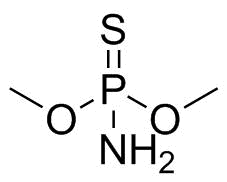 |
| Molecular Formula | C2H8NO2PS |
| Molecular Weight | 141.12 |
| CAS Registry Number | 17321-47-0 |
| EC Number | 241-342-2 |
| SMILES | COP(=S)(N)OC |
| Density | 1.3±0.1 g/cm3 Calc.* |
|---|---|
| Boiling point | 162.2±23.0 °C 760 mmHg (Calc.)* |
| Flash point | 51.9±22.6 °C (Calc.)* |
| Index of refraction | 1.502 (Calc.)* |
| * | Calculated using Advanced Chemistry Development (ACD/Labs) Software. |
| Hazard Symbols |    GHS07;GHS08;GHS09 Danger Details GHS07;GHS08;GHS09 Danger Details |
|---|---|
| Risk Statements | H302+H312-H410-H372 Details |
| Safety Statements | P264-P270-P280-P301+P312+P330-P302+P352+P312-P363-P501 Details |
| Transport Information | UN 3334 |
| SDS | Available |
 chemBlink Chemical Story
|
O,O-Dimethyl phosphoramidothioate, often abbreviated DMPAT in process literature, is not famous as a consumer product. Its importance lies inside a manufacturing sequence. It is an organophosphorus intermediate used in routes leading to methamidophos and acephate, and its story shows why the safety of a chemical plant may depend more on short-lived intermediates than on the final product leaving the site. The molecule contains a phosphorus center bonded to methoxy groups, sulfur, and an amino functionality. That arrangement places it in the reactive organophosphorus chemistry used to build certain insecticides. In conventional multistep manufacturing, an intermediate might be synthesized, isolated, purified, stored, and then charged to the next reactor. Every isolation step creates opportunities for worker exposure, decomposition, contamination, and accumulation of a larger inventory of reactive material. Modern patents for acephate manufacture explicitly address this problem. Process developers have described routes in which reactive intermediates, including DMPAT-related material, are kept in solution and carried directly into the next step rather than isolated as neat substances. Such 'telescoped' processing is a major concept in process chemistry: when an intermediate is unstable or hazardous, the safest material to store may be the one that is never stored at all. In the acephate sequence, organophosphorus intermediates are transformed through sulfur- and nitrogen-containing phosphorus chemistry before the final insecticide is obtained. Methamidophos is closely related chemically and is also an important transformation product associated with acephate chemistry. Environmental studies of acephate degradation have examined how microorganisms and chemical processes break down these phosphorus-containing structures, emphasizing that manufacturing chemistry and environmental fate are connected parts of the life cycle. This story should not be reduced to a detailed operating recipe. With reactive organophosphorus intermediates, the useful lesson is process design rather than step-by-step conditions. Reaction calorimetry, concentration control, solvent choice, impurity management, containment, and avoidance of unnecessary isolation are the kinds of decisions that determine whether a route can be scaled safely. Patents discussing explosion or decomposition hazards are evidence that synthetic efficiency cannot be separated from hazard engineering. O,O-Dimethyl phosphoramidothioate is memorable because it represents the invisible chemistry between raw material and commercial product. The public usually sees the final pesticide; the process chemist sees a chain of intermediates whose inventories and reactivities must be controlled. In modern manufacturing, redesigning the route so that a hazardous intermediate exists only briefly and in dilute solution can be as important as improving the chemical yield. References: 1. WO2020018914A1, processes for manufacture of acephate and related organophosphorus intermediates. 2. US10669295B2 and US11198700B2, process patents discussing DMPAT-related intermediates and safer telescoped handling. 3. Singh B.K. et al. Biodegradation/mineralization of acephate and related transformation chemistry. PLoS ONE. 2012. DOI: 10.1371/journal.pone.0031963. 4. Process-safety literature on hazard reduction by telescoping reactive intermediates. |
| Market Analysis Reports |