
Online Database of Chemicals from Around the World
| Shanghai PI Chemicals Ltd. | China | |||
|---|---|---|---|---|
 | www.pipharm.com | |||
 | +86 (21) 58953700 | |||
 | +86 (21) 58953701 | |||
 | sales@pipharm.com | |||
| Chemical distributor since 2007 | ||||
| chemBlink Standard supplier since 2026 | ||||
| Classification | Organic raw materials >> Heterocyclic compound |
|---|---|
| Name | Hypoxanthine disodium |
| Molecular Structure | 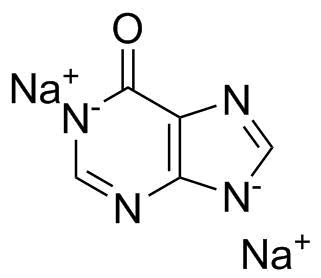 |
| Molecular Formula | C5H2N4Na2O |
| Molecular Weight | 180.08 |
| CAS Registry Number | 199329-61-8 |
| EC Number | 964-140-2 |
| SMILES | C1=NC2=C([N-]1)N=C[N-]C2=O.[Na+].[Na+] |
| Hazard Symbols |  GHS05 Danger Details | ||||||||
|---|---|---|---|---|---|---|---|---|---|
| Risk Statements | H318 Details | ||||||||
| Safety Statements | P280-P310-P305+P351+P338 Details | ||||||||
| Hazard Classification | |||||||||
| |||||||||
| Transport Information | UN 1759 | ||||||||
| SDS | Available | ||||||||
 chemBlink Chemical Story
|
Hypoxanthine disodium is a salt form of a purine base that sits at a junction between nucleotide recycling and breakdown. The parent hypoxanthine has a fused five- and six-membered ring system, with a carbonyl at position 6 and no attached sugar or phosphate. Its disodium registry record represents a formally doubly deprotonated organic component with two sodium ions. That distinguishes the weighed reagent from free hypoxanthine, inosine and inosine monophosphate, even though all four names occur in discussions of purine metabolism. The difference between those last three compounds is especially useful. Attaching ribose to the base produces the nucleoside inosine. Attaching phosphate to the ribose produces a nucleotide. Hypoxanthine can enter the salvage pathway through hypoxanthine-guanine phosphoribosyltransferase, usually abbreviated HPRT or HGPRT. The enzyme transfers a phosphoribosyl group from PRPP to hypoxanthine to make inosine monophosphate. This is a route for recovering a pre-existing purine ring rather than assembling that ring from smaller precursors. The nucleotide can then feed pathways to adenine and guanine nucleotides. Alternatively, hypoxanthine can be oxidized toward xanthine and uric acid in purine breakdown. The biochemical value of salvage became an experimental tool in cell selection. Hypoxanthine is the H in HAT medium, whose other named components are aminopterin and thymidine. Aminopterin interferes with folate-dependent de novo nucleotide synthesis. Providing the salvage substrates makes survival depend on the appropriate salvage machinery. The details depend on which mutations and cell types are being compared; adding hypoxanthine alone does not identify a hybrid cell. Littlefield's 1964 work on hybrid mouse fibroblasts is an early landmark in the use of this logic. In such experiments, metabolism acts as a selection rule. If two parental cell populations have complementary defects, a hybrid may recover functions that neither parent supplies on its own under the selective conditions. This approach helped make cell fusion experimentally tractable and forms part of the background to later hybridoma methods. The historical significance belongs to hypoxanthine-dependent selection, not to a demonstration that the disodium salt alone had some unique ability to recognize hybrids. Salt identity and biological selection mechanism are separate parts of the account. The disodium material also illustrates how much can change between a bottle and a culture medium. Protonation in water depends on pH. A formally doubly negative drawing in a registry does not mean that the same charge state dominates after dilution into a buffered medium. A manufacturer's certificate for one lot reports an alkaline aqueous solution and checks identity by infrared and ultraviolet measurements. Those are observations on a specified sample under specified conditions; the pH is not an intrinsic constant independent of concentration. The mass used to prepare an amount of hypoxanthine equivalents also needs to account for the sodium component and any relevant water content. The two salvage substrates in HAT also serve different branches. Hypoxanthine supplies a purine base for nucleotide recovery, whereas thymidine already contains a sugar and belongs to pyrimidine metabolism. Thymidine kinase can phosphorylate it, making its contribution depend on a different enzyme from HPRT. This separation is what allows complementary metabolic defects to be used in a selection scheme. The ingredients are not interchangeable general nutrients; they provide particular bypasses around the blocked synthetic routes. For this reagent, the interesting application is therefore a link between two kinds of precision. Chemical precision identifies which salt was weighed. Biological precision identifies which metabolic route was made essential by the experiment. Confusing the two can turn a well-established selection principle into an unsupported claim about a particular formulation. References: 1. PubChem. Hypoxanthine disodium, CID 44537592. https://pubchem.ncbi.nlm.nih.gov/compound/44537592 2. MP Biomedicals. Hypoxanthine disodium salt, batch S6903 certificate. https://www.mpbio.com/media/document/infor/S/6/9/0/3/S6903.pdf 3. Littlefield JW. The selection of hybrid mouse fibroblasts. Cold Spring Harb Symp Quant Biol. 1964;29:161–166. https://pubmed.ncbi.nlm.nih.gov/14278462/ |
| Market Analysis Reports |