
Online Database of Chemicals from Around the World
| Shanghai PI Chemicals Ltd. | China | |||
|---|---|---|---|---|
 | www.pipharm.com | |||
 | +86 (21) 58953700 | |||
 | +86 (21) 58953701 | |||
 | sales@pipharm.com | |||
| Chemical distributor since 2007 | ||||
| chemBlink Standard supplier since 2026 | ||||
| Classification | Organic raw materials >> Carboxylic compounds and derivatives |
|---|---|
| Name | (S,R.S)-AHPC-PEG4-acid |
| Synonyms | 3-[2-[2-[2-[3-[[(2S)-1-[(2S,4R)-4-hydroxy-2-[[4-(4-methyl-1,3-thiazol-5-yl)phenyl]methylcarbamoyl]pyrrolidin-1-yl]-3,3-dimethyl-1-oxobutan-2-yl]amino]-3-oxopropoxy]ethoxy]ethoxy]ethoxy]propanoic acid |
| Molecular Structure | 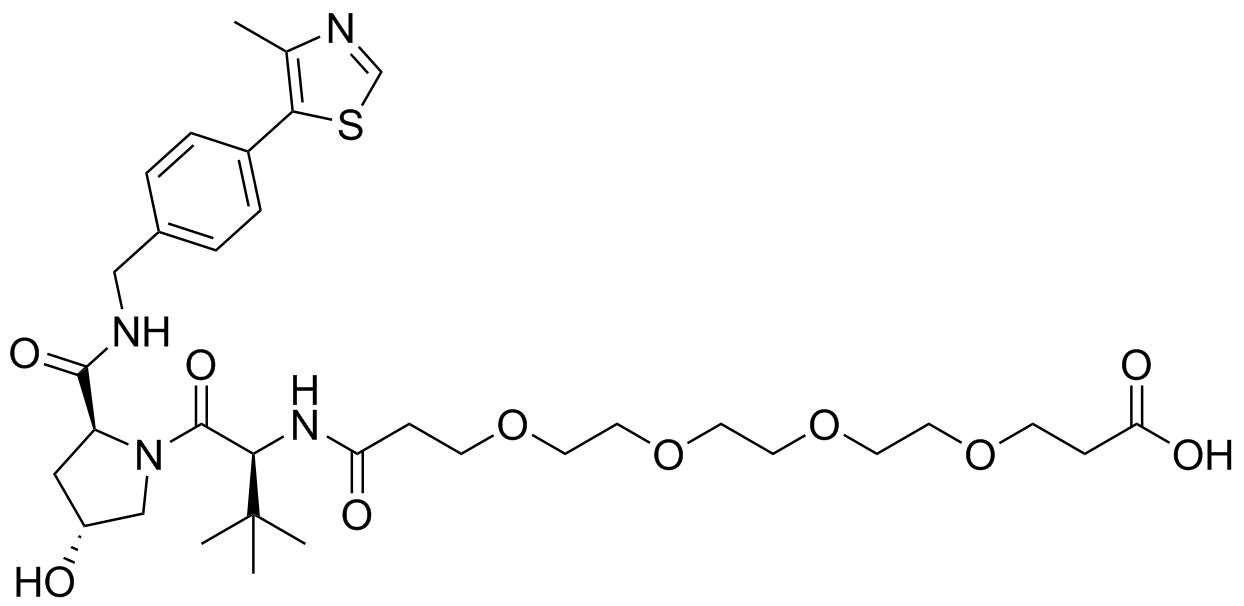 |
| Molecular Formula | C34H50N4O10S |
| Molecular Weight | 706.85 |
| CAS Registry Number | 2172820-12-9 |
| SMILES | CC1=C(SC=N1)C2=CC=C(C=C2)CNC(=O)[C@@H]3C[C@H](CN3C(=O)[C@H](C(C)(C)C)NC(=O)CCOCCOCCOCCOCCC(=O)O)O |
| Density | 1.3±0.1 g/cm3 Calc.* |
|---|---|
| Boiling point | 950.9±65.0 °C 760 mmHg (Calc.)* |
| Flash point | 528.9±34.3 °C (Calc.)* |
| Index of refraction | 1.56 (Calc.)* |
| * | Calculated using Advanced Chemistry Development (ACD/Labs) Software. |
| Hazard Symbols |  GHS07 Warning Details |
|---|---|
| Risk Statements | H302-H315-H319 Details |
| Safety Statements | P501-P270-P264-P280-P302+P352-P337+P313-P305+P351+P338-P362+P364-P332+P313-P301+P312+P330 Details |
| SDS | Available |
 chemBlink Chemical Story
|
AHPC-PEG4-acid, also described as VH 032 amide-PEG4-acid, puts a VHL-directed recognition element at one end of a flexible chain. The other end is a carboxylic acid available for further conjugation. Its hydroxyproline-containing scaffold is quite different from the glutarimide scaffolds used to recruit cereblon. VHL and cereblon participate in different E3 ubiquitin ligase complexes. A common linker length therefore does not make their ligand-bearing building blocks functionally interchangeable. Stereochemistry is central to the VHL-facing portion. The full structural name specifies a hydroxyproline ring with defined configurations and a second stereogenic center in an adjacent amino-acid-derived segment. The compact label (S,R,S) summarizes three configurations, not three ingredients or a mixture of randomly oriented molecules. The English name in the source list has punctuation written as (S,R.S); the structural assignment is clearer in the manufacturer's full systematic name. Keeping the original database name while checking the defined structure avoids silently turning a typographical variant into an assertion about a different stereoisomer. The hydroxyproline framework reflects the biology of VHL recognition. VHL recognizes appropriately hydroxylated protein substrates in oxygen sensing, and small-molecule ligands were developed to engage its binding pocket. Here that recognition element is connected through an amide to an oxygen-rich spacer. The acid at the opposite end can be converted into a linkage to a target-binding portion. Until that portion is present, the molecule does not specify which target protein a completed bifunctional degrader would recruit. The available acid is a synthesis platform, not a universal degradation instruction. Why this distinction matters became unusually visible in structural work published in 2017. Gadd and colleagues examined MZ1, a different molecule that links a BET bromodomain-binding ligand to a VHL ligand. They determined a structure of the three-component complex containing the degrader, VHL and a BRD4 bromodomain. The two proteins made contacts with each other as well as with the small molecule. Those contacts helped explain cooperative recognition and preferential behavior among related protein domains. The linker was part of the geometry that made those contacts possible, rather than an inert line between independent binding sites. MZ1 in that study used a three-unit PEG linker. It is not the PEG4 acid in this entry, and the crystal structure cannot establish the activity of a conjugate that has not been made and tested. The comparison instead explains why researchers prepare families of related building blocks. Changing length or attachment position can alter how proteins meet, even when each individual binding element remains recognizable. An affinity measurement for one binding partner cannot capture all those geometric consequences. The adjacent peptide-like bonds also restrict some local motions even though the ether chain has many rotatable bonds. A longer chain supplies more possible conformations, not simply a larger fixed separation. Some of those conformations may allow productive contacts while others do not. This is why a single extended chemical drawing is a poor substitute for structural or biophysical measurements of the assembled complex. The building block specifies connectivity; it does not specify the final arrangement of the two protein surfaces. For AHPC-PEG4-acid, the documented utility is access to such comparisons through modular synthesis. The stereochemically specified VHL-facing half, the ether spacer and the terminal acid define the reagent. A finished molecule then needs its own evidence for binding, ternary-complex formation and degradation. Read together, the building-block specification and the structural literature show how a seemingly modest synthetic connection becomes part of an experiment about protein recognition in three dimensions. References: 1. Tocris. VH 032 amide-PEG4-acid, CAS 2172820-12-9. https://www.rndsystems.com/cn/products/vh-032-amide-peg4-acid_7215 2. Gadd MS et al. Structural basis of PROTAC cooperative recognition for selective protein degradation. Nat Chem Biol. 2017;13:514–521. https://pmc.ncbi.nlm.nih.gov/articles/PMC5392356/ |
| Market Analysis Reports |