
Online Database of Chemicals from Around the World
| Tianjin ComoraTechnology Co., Ltd. | China | |||
|---|---|---|---|---|
 | comoratj.com | |||
 | +86 15908635794 | |||
 | sales@comoratj.com | |||
 | WhatsApp:+86 15908635794 | |||
| Chemical manufacturer since 2026 | ||||
| chemBlink Standard supplier since 2026 | ||||
| Classification | Organic raw materials >> Carboxylic compounds and derivatives |
|---|---|
| Name | 4-Methoxycarbonylcubanecarboxylic acid |
| Molecular Structure | 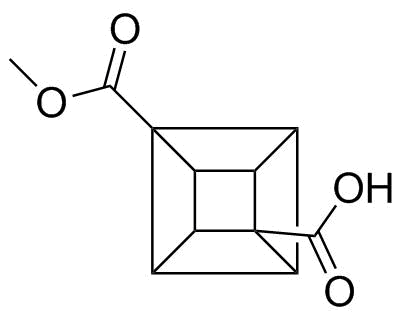 |
| Molecular Formula | C11H10O4 |
| Molecular Weight | 206.19 |
| CAS Registry Number | 24539-28-4 |
| EC Number | 691-562-1 |
| SMILES | COC(=O)C12C3C4C1C5C2C3C45C(=O)O |
| Density | 2.0±0.1 g/cm3 Calc.* |
|---|---|
| Boiling point | 341.5±42.0 °C 760 mmHg (Calc.)* |
| Flash point | 141.4±21.4 °C (Calc.)* |
| Index of refraction | 1.822 (Calc.)* |
| * | Calculated using Advanced Chemistry Development (ACD/Labs) Software. |
| Hazard Symbols |  GHS07 Warning Details | ||||||||||||||||||||
|---|---|---|---|---|---|---|---|---|---|---|---|---|---|---|---|---|---|---|---|---|---|
| Risk Statements | H315-H319-H335 Details | ||||||||||||||||||||
| Safety Statements | P261-P264-P264+P265-P271-P280-P302+P352-P304+P340-P305+P351+P338-P319-P321-P332+P317-P337+P317-P362+P364-P403+P233-P405-P501 Details | ||||||||||||||||||||
| Hazard Classification | |||||||||||||||||||||
| |||||||||||||||||||||
| SDS | Available | ||||||||||||||||||||
 chemBlink Chemical Story
|
4-(Methoxycarbonyl)cubane-1-carboxylic acid brings an almost diagrammatic shape into practical organic chemistry. Its central cage places eight carbon atoms at the corners of a cube, joined along the edges. Two opposite cage positions carry carbonyl-containing substituents: one is a free carboxylic acid and the other is a methyl ester. The molecule therefore combines a rigid three-dimensional framework with two related but chemically distinguishable handles. It is a functionalized building block, not simply the parent hydrocarbon cubane. That distinction explains much of its usefulness. A free acid can be activated for coupling while a methyl ester is retained for a later transformation, provided the chosen conditions are compatible. The two groups need not be modified at the same time. This differentiated design provides a way to connect one end of the cage to a partner while preserving another point for further elaboration. It also explains why the monoacid-monoester must be distinguished from both cubane-1,4-dicarboxylic acid and its dimethyl ester: similar names conceal different possibilities for controlling a sequence. The cage itself invites comparison with more familiar molecular shapes. Benzene is flat and aromatic; cubane is a saturated carbon cage. Opposite substituents on a cubane can provide an alternative spatial arrangement to substituents across a benzene ring, which has encouraged investigation of cubane as a benzene bioisostere. A bioisostere is a replacement considered for its ability to preserve useful properties in a particular molecular setting. The term describes a design hypothesis to test, not a guarantee that two fragments have identical electronic behavior or biological effects. This wider idea received experimental support in a 2016 study by Chalmers and colleagues. They prepared and evaluated cubane analogues of several biologically active molecules, obtaining outcomes that depended on the molecule being modified. The relevance to a reagent such as this monoacid-monoester is contextual: functionalized cages give researchers ways to build and compare new structures. The biological results of those completed analogues cannot be assigned to the unelaborated building block, and a promising scaffold replacement in one series does not ensure success in another. The free acid also opens a less obvious pathway. Sigma-Aldrich identifies this specific compound as a substrate for iododecarboxylation using an N-iodoamide under irradiation. In such a transformation, the carboxyl group supplies a route to a carbon-iodine connection through loss of carbon dioxide. The 2011 method paper describes a broader metal-free approach to converting carboxylic acids into organic iodides. For the cubane reagent, this provides a documented example of treating the acid as a transformable handle rather than merely as a permanent attachment group. The enduring interest of the molecule lies in the combination of shape and differentiation. A drawing of a cube alone says little about how a useful target can be assembled. A cube carrying one free acid and one protected acid offers an ordered way forward, allowing the two ends to play different roles. Whether the goal is a new synthetic intermediate or an analogue for biological testing, the final result still requires characterization and evaluation. The reagent's contribution is to make a distinctive carbon framework accessible for those experiments without confusing the potential of the cage with a demonstrated property of every compound that contains it. Even its two carbonyl groups have different immediate roles. One includes an acidic hydroxyl group, while the other includes a methoxy group. Reading that small distinction correctly is what turns an appealing cage drawing into a usable reaction plan, and prevents accidental substitution of the diacid or diester. References: 1. Sigma-Aldrich. 4-Methoxycarbonylcubanecarboxylic acid, 901001; identity and iododecarboxylation application. https://www.sigmaaldrich.com/US/en/product/aldrich/901001 2. Kulbitski K et al. Metal-Free Efficient, General and Facile Iododecarboxylation Method with Biodegradable Co-Products. Adv Synth Catal. 2011;353:1438-1442. DOI: 10.1002/adsc.201100145. https://advanced.onlinelibrary.wiley.com/doi/abs/10.1002/adsc.201100145 3. Chalmers BA et al. Validating Eaton's Hypothesis: Cubane as a Benzene Bioisostere. Angew Chem Int Ed. 2016;55:3580-3585. DOI: 10.1002/anie.201510675. https://pubmed.ncbi.nlm.nih.gov/26846616/ |
| Market Analysis Reports |