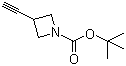
Small saturated nitrogen rings are useful starting points for building three-dimensional molecules. tert-Butyl 3-ethynylazetidine-1-carboxylate, CAS 287193-01-5, combines one such ring with two deliberately different synthetic features: a terminal alkyne at carbon 3 and a Boc-protected nitrogen. The four-membered azetidine ring supplies the framework, while the two functional elements help organize how it can be elaborated.
The name requires careful reading. The tert-butyl carboxylate unit is attached through the ring nitrogen as a carbamate, commonly called a Boc protecting group. It is not a free carboxylic acid substituent on carbon 3. That carbon instead bears the ethynyl group. Confusing these features would give a misleading picture of both the structure and the possible transformations.
A specific application appears in patent US20220202963A1, titled Radiolabeled compounds. Its experimental section explicitly identifies this CAS number and uses the terminal alkyne in couplings with aromatic bromides. The products retain the azetidine framework and contain an aryl-substituted alkyne. This is direct evidence of the building block's role in carbon-carbon bond construction. The patent title does not mean that the starting reagent is itself radioactive.
The arrangement illustrates the logic of staged synthesis. The alkyne provides a defined point for extending the carbon framework, while temporary protection changes the availability of the nitrogen. Subsequent transformations can then be planned around the requirements of the intended target. Whether a particular sequence succeeds depends on the actual substrates and conditions; the presence of an alkyne alone does not establish compatibility with every coupling method.
It is also important to distinguish a synthetic role from a biological claim. A starting material used in the preparation of a research compound does not automatically share the final compound's binding properties, imaging performance, or therapeutic relevance. Those properties require evidence for the actual molecule being tested. The verified story here is one of molecular construction.
This azetidine derivative therefore offers a concise example of how chemists package several useful decisions into a small reagent: a preformed saturated ring, a protected nitrogen, and an outward-facing carbon-carbon triple bond. The combination provides a manageable starting architecture for making more complex structures without having to build the ring anew in every sequence.
References:
1. Ambeed. tert-Butyl 3-ethynylazetidine-1-carboxylate, CAS 287193-01-5. https://www.ambeed.com/products/287193-01-5.html
2. US20220202963A1. Radiolabeled compounds; experimental aryl-alkyne coupling examples explicitly identify CAS 287193-01-5. https://patents.google.com/patent/US20220202963A1/en
|






 GHS07 Warning Details
 chemBlink Chemical Story