
Online Database of Chemicals from Around the World
| Simagchem Corporation | China | |||
|---|---|---|---|---|
 | www.simagchem.com | |||
 | +86 13806087780 | |||
 | +86 (592) 268-0237 | |||
 | sale@simagchem.com | |||
| Chemical manufacturer since 2002 | ||||
| chemBlink Standard supplier since 2008 | ||||
| BOC Sciences | USA | |||
|---|---|---|---|---|
| www.bocsci.com | |||
| +1 (631) 485-4226 | |||
| +1 (631) 614-7828 | |||
| info@bocsci.com | |||
| Chemical manufacturer | ||||
| chemBlink Standard supplier since 2010 | ||||
| Active biopharma Corp | China | |||
|---|---|---|---|---|
| www.activebiopharma.com | |||
| +86 (571) 8161-2335 | |||
| support@activebiopharma.com | |||
| Chemical manufacturer | ||||
| chemBlink Standard supplier since 2012 | ||||
| Hangzhou Leap Chem Co., Ltd. | China | |||
|---|---|---|---|---|
| www.leapchem.com | |||
| +86 (571) 8771-1850 | |||
| market19@leapchem.com | |||
 | QQ Chat | |||
| Chemical manufacturer since 2006 | ||||
| chemBlink Standard supplier since 2015 | ||||
| Tianjin ComoraTechnology Co., Ltd. | China | |||
|---|---|---|---|---|
| comoratj.com | |||
| +86 15908635794 | |||
| sales@comoratj.com | |||
 | WhatsApp:+86 15908635794 | |||
| Chemical manufacturer since 2026 | ||||
| chemBlink Standard supplier since 2026 | ||||
| Achemica | Switzerland | |||
|---|---|---|---|---|
| www.achemica.com | |||
| +41 (24) 466-2929 | |||
| +41 (24) 466-2800 | |||
| contact@achemica.com | |||
| Chemical manufacturer since 2010 | ||||
| Classification | Organic raw materials >> Heterocyclic compound |
|---|---|
| Name | 2,9-Dichloro-1,10-phenanthroline |
| Synonyms | 2,9-Dichloro-o-phenanthroline; NSC 608430; VUF 7732 |
| Molecular Structure | 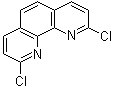 |
| Molecular Formula | C12H6Cl2N2 |
| Molecular Weight | 249.09 |
| CAS Registry Number | 29176-55-4 |
| SMILES | C1=CC2=C(C3=C1C=CC(=N3)Cl)N=C(C=C2)Cl |
| Solubility | Insoluble (9.2E-3 g/L) (25 °C), Calc.* |
|---|---|
| Density | 1.482±0.06 g/cm3 (20 °C 760 Torr), Calc.* |
| Melting point | 249-250 °C** |
| Boiling point | 417.3±40.0 °C 760 mmHg (Calc.)* |
| Flash point | 238.7±12.9 °C (Calc.)* |
| Index of refraction | 1.742 (Calc.)* |
| * | Calculated using Advanced Chemistry Development (ACD/Labs) Software V11.02 (©1994-2013 ACD/Labs) |
| ** | Yamada, Masaki |
| Hazard Symbols |  GHS07 Warning Details |
|---|---|
| Risk Statements | H315-H319-H335 Details |
| Safety Statements | P261-P305+P351+P338 Details |
| SDS | Available |
 chemBlink Chemical Story
|
A metal-binding molecule can also be a starting point for redesigning the space around a metal. 2,9-Dichloro-1,10-phenanthroline, CAS 29176-55-4, illustrates this dual role. Its fused aromatic framework contains two nitrogen atoms arranged for chelation, while chlorine substituents occupy the nearby 2 and 9 positions. The nitrogen pair offers a coordination site; the substituted carbons offer opportunities for changing the surrounding architecture. The position numbers are especially informative. In phenanthroline chemistry, groups close to the donor nitrogens can influence the space available to other ligands and reacting molecules. Replacing a substituent at these positions can change more than molecular weight. It can alter how closely another component can approach the metal and how the ligand fits into a larger assembly. Such effects are investigated for the complete complex rather than predicted from a single substituent alone. A 1990 paper described preparation of this dichloro compound from annelated phenanthrolinediones. Its subsequent use reflects the value of an intermediate whose ring system is already assembled. Chemists can elaborate the periphery while retaining the underlying nitrogen-containing framework, rather than rebuilding the fused rings for each new design. One instructive example is a 2005 Inorganic Chemistry study of a larger terphenanthroline ligand prepared from this starting material. The work showed how an accessible phenanthroline derivative could lead to an architecture with several donor sites and distinctive metal-dependent assembly. The larger ligand and its complexes were different substances from the original dichloro reagent, but their construction made use of its preorganized framework. The compound can also appear directly in coordination-materials research. A study of copper iodide organic-inorganic hybrids included a cluster containing 2,9-dichloro-1,10-phenanthroline and investigated luminescent coating materials. This application places the molecule in an assembled metal-containing environment. Optical behavior in such a material depends on the whole coordination structure, so it should not be attributed to the isolated ligand without separate measurements. These examples reveal two complementary design strategies. One changes the organic molecule before metal binding, using it as a precursor to more elaborate ligands. The other incorporates the existing molecule into a coordination assembly. In both cases, identifying the exact substitution pattern is essential: a 2,9-dichloro derivative is not interchangeable with chlorination elsewhere on the phenanthroline ring system. The donor atoms in this framework are aromatic nitrogens, not amino groups attached to the outside of a ring. Their lone pairs can participate in coordination while the fused carbon framework maintains its overall organization. Binding through two sites of one molecule is described as chelation. It ties the positions of the donor atoms together, which is a different situation from providing two unrelated nitrogen-containing molecules. For a luminescent coordination material, several structural levels can matter simultaneously. The organic ligand affects the local environment, the metal and other ligands define additional interactions, and the packing of the assembled species adds a solid-state setting. Distinguishing these levels helps explain why changing a peripheral substituent can be a useful experiment without making the substituent alone responsible for every observed property. Comparing well-characterized members of a series is the way to test that relationship. Its chemical story is therefore about controlled construction around a familiar donor pair. A rigid aromatic skeleton supplies organization, the two nitrogen atoms supply coordination opportunities, and the neighboring substituted positions help researchers explore how local structure affects a larger metal-containing system. References: 1. Synthesis of 2,9-Dichloro-1,10-phenanthroline from N,N'-Annelated Phenanthrolinediones. Bull Chem Soc Jpn. 1990;63:2710-2712. https://doi.org/10.1246/bcsj.63.2710 2. 2,2';9',2''-Ter[1,10]phenanthroline. Inorg Chem. 2005. https://doi.org/10.1021/ic050712w 3. Copper iodide organic-inorganic hybrid chelating clusters as luminescent coating materials. Inorganica Chimica Acta. https://www.sciencedirect.com/science/article/abs/pii/S0020169320314419 |
| Market Analysis Reports |