
Online Database of Chemicals from Around the World
| Tianjin ComoraTechnology Co., Ltd. | China | |||
|---|---|---|---|---|
 | comoratj.com | |||
 | +86 15908635794 | |||
 | sales@comoratj.com | |||
 | WhatsApp:+86 15908635794 | |||
| Chemical manufacturer since 2026 | ||||
| chemBlink Standard supplier since 2026 | ||||
| Classification | Organic raw materials >> Carboxylic compounds and derivatives |
|---|---|
| Name | 1,4-Cubanedicarboxylic acid |
| Synonyms | cubane-1,4-dicarboxylic acid |
| Molecular Structure | 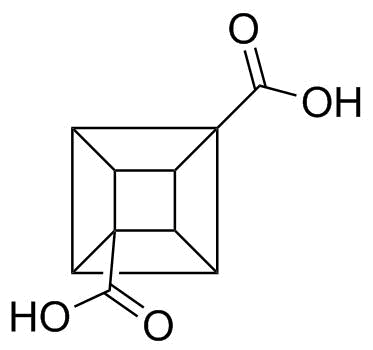 |
| Molecular Formula | C10H8O4 |
| Molecular Weight | 192.17 |
| CAS Registry Number | 32846-66-5 |
| EC Number | 809-101-1 |
| SMILES | C12C3C4C1(C5C2C3(C45)C(=O)O)C(=O)O |
| Density | 2.4±0.1 g/cm3 Calc.* |
|---|---|
| Boiling point | 457.4±45.0 °C 760 mmHg (Calc.)* |
| Flash point | 244.6±25.2 °C (Calc.)* |
| Index of refraction | 2.042 (Calc.)* |
| * | Calculated using Advanced Chemistry Development (ACD/Labs) Software. |
| Hazard Symbols |  GHS06 Danger Details | ||||||||||||||||||||
|---|---|---|---|---|---|---|---|---|---|---|---|---|---|---|---|---|---|---|---|---|---|
| Risk Statements | H301 Details | ||||||||||||||||||||
| Safety Statements | P264-P270-P301+P316-P321-P330-P405-P501 Details | ||||||||||||||||||||
| Hazard Classification | |||||||||||||||||||||
| |||||||||||||||||||||
| SDS | Available | ||||||||||||||||||||
 chemBlink Chemical Story
|
A cube is an unusual shape for an organic molecule, but cubane turns that geometric idea into a carbon framework. Eight carbon atoms occupy the corners of the cage. In 1,4-cubanedicarboxylic acid, CAS 32846-66-5, two carboxylic acid groups extend from opposite vertices. The result is a compact, rigid connector with two chemically useful ends. Its importance comes from the combination of attachment direction and a three-dimensional hydrocarbon surface. The two acid groups can lose their acidic protons to provide carboxylate binding sites. Those sites allow the molecule to connect metal-containing units in coordination materials. The cage between them provides a different local environment from a flat aromatic ring. This distinction matters because an adsorbed molecule encounters the inside surface of a porous material, not simply the formula of its linker. A change in the connector can therefore change the character of the space around a guest without requiring an entirely different network design. A concrete example appeared in 2019, when Macreadie and colleagues reported CUB-5. They combined the cubane-derived dicarboxylate with zinc-oxygen clusters to make a framework related in connectivity to MOF-5. The work associated benzene adsorption with the unusual aliphatic pore environment. It established a materials application for this particular diacid while leaving industrial separation performance as a subject for further investigation. That result also clarifies what the product is. The free diacid is a molecular building block; CUB-5 is an extended structure assembled from that building block and metal-containing nodes. Measurements on the assembled framework do not describe the adsorption capacity of a bottle of the free acid. Likewise, an ester of the same cage has different functional groups and should not be substituted in a discussion of carboxylate coordination without explaining the conversion. The broader design lesson is that molecular geometry can be a functional variable. Linker length, the direction of its two ends, and the surface presented between them all help define the eventual material. This makes 1,4-cubanedicarboxylic acid an instructive bridge between cage chemistry and porous-solid research: a small, precisely shaped molecule can help determine the environment inside a much larger structure. References: 1. Macreadie LK et al. CUB-5: A Contoured Aliphatic Pore Environment in a Cubic Framework with Potential for Benzene Separation Applications. J Am Chem Soc. 2019;141:3828-3832. https://doi.org/10.1021/jacs.8b13639 2. J-GLOBAL. Cubane-1,4-dicarboxylic acid: substance identity, CAS 32846-66-5. https://jglobal.jst.go.jp/en/detail?JGLOBAL_ID=200907005446907788 |
| Market Analysis Reports |