
Online Database of Chemicals from Around the World
| Jiangsu Haixiang Chemical Industry Co., Ltd. | China | |||
|---|---|---|---|---|
 | www.hx-chem.com | |||
 | +86 (519) 8019-1677 | |||
 | +86 (519) 8233-0677 | |||
 | michaelliorama@gmail.com | |||
| Chemical manufacturer | ||||
| chemBlink Standard supplier since 2007 | ||||
| Lontr Science & Technology Industrial Co., Ltd. | China | |||
|---|---|---|---|---|
| www.lontr.com | |||
| +86 (25) 8434-1022 | |||
| +86 (25) 8434-1022 | |||
| zjb298680@163.com zjb29868@hotmail.com | |||
| Chemical manufacturer since 2004 | ||||
| chemBlink Standard supplier since 2010 | ||||
| BOC Sciences | USA | |||
|---|---|---|---|---|
| www.bocsci.com | |||
| +1 (631) 485-4226 | |||
| +1 (631) 614-7828 | |||
| info@bocsci.com | |||
| Chemical manufacturer | ||||
| chemBlink Standard supplier since 2010 | ||||
| SynQuest Labs, Inc. | USA | |||
|---|---|---|---|---|
| www.synquestlabs.com | |||
| +1 (386) 462-0788 | |||
| +1 (386) 462-7097 | |||
| Sales@synquestlabs.com | |||
| Chemical manufacturer | ||||
| chemBlink Standard supplier since 2011 | ||||
| LONGRE Pharmaceuticals Co., Ltd. | China | |||
|---|---|---|---|---|
| www.longrepharm.com | |||
| +86 (512) 6959-2836 +86 13306132836 | |||
| +86 (512) 6959-2835 | |||
| sales@longrepharm.com yuguojun1013@163.com | |||
| Chemical manufacturer since 2011 | ||||
| chemBlink Standard supplier since 2011 | ||||
| Aromsyn Co., Ltd. | China | |||
|---|---|---|---|---|
| www.aromsyn.com | |||
| +86 (571) 8558-5865 +86 13336024896 | |||
| +86 (571) 8558-5865 | |||
| service@aromsyn.com | |||
 | QQ Chat | |||
| Chemical manufacturer | ||||
| chemBlink Standard supplier since 2012 | ||||
| INA Pharmaceuticals Pvt. Ltd. | India | |||
|---|---|---|---|---|
| inapharma.in | |||
| +91 7815933367 | |||
| rd@inapharma.in | |||
| Chemical manufacturer since 2018 | ||||
| chemBlink Standard supplier since 2026 | ||||
| Marshallton Research Laboratories | USA | |||
|---|---|---|---|---|
| www.marshalltonlabs.com | |||
| +1 (336) 983-2131 | |||
| +1 (336) 983-0096 | |||
| marshallton@windstream.net | |||
| Chemical manufacturer since 1974 | ||||
| Melford Laboratories Limited | UK | |||
|---|---|---|---|---|
| www.melford.co.uk | |||
| +44 (1449) 741-178 | |||
| +44 (1449) 741-217 | |||
| pfranklin@melford.co.uk sales@melford.co.uk | |||
| Chemical manufacturer since 1985 | ||||
| Oakwood Products, Inc. | USA | |||
|---|---|---|---|---|
| www.oakwoodchemical.com | |||
| +1 (800) 467-3386 | |||
| k_weaver@oakwoodchemical.com | |||
| Chemical manufacturer | ||||
| Ricci Chimica | Italy | |||
|---|---|---|---|---|
| www.riccichimica.com | |||
| +39 (75) 692-9241 | |||
| +39 (75) 592-6595 | |||
| info@riccichimica.com | |||
| Chemical manufacturer | ||||
| Frontier Scientific Services, Inc. | USA | |||
|---|---|---|---|---|
| www.frontierssi.com | |||
| +1 (302) 266-6891 (888) 577-2734 | |||
| +1 (302) 266-8296 | |||
| customerservice@frontierssi.com | |||
| Chemical manufacturer | ||||
| Syntech Labs, Inc. | USA | |||
|---|---|---|---|---|
| www.syntechlabs.com | |||
| +1 (732) 545-8380 | |||
| +1 (732) 545-6881 | |||
| info@syntechlabs.com | |||
| Chemical manufacturer | ||||
| Classification | Organic raw materials >> Organic fluorine compound >> Fluorobenzonitrile series |
|---|---|
| Name | 3-Fluorophenylacetonitrile |
| Synonyms | 3-Fluorobenzeneacetonitrile; 3-Fluorobenzyl cyanide |
| Molecular Structure | 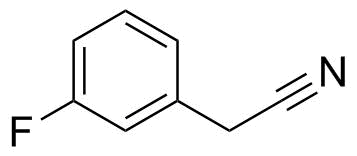 |
| Molecular Formula | C8H6FN |
| Molecular Weight | 135.14 |
| CAS Registry Number | 501-00-8 |
| EC Number | 207-918-2 |
| SMILES | C1=CC(=CC(=C1)F)CC#N |
| Density | 1.1±0.1 g/cm3 Calc.*, 1.163 g/mL (Expl.) |
|---|---|
| Boiling point | 226.8 °C 760 mmHg (Calc.)*, 248.6 - 249.9 °C (Expl.) |
| Flash point | 83.1±24.1 °C (Calc.)*, 113 °C (Expl.) |
| Index of refraction | 1.508 (Calc.)*, 1.502 (Expl.) |
| * | Calculated using Advanced Chemistry Development (ACD/Labs) Software. |
| Hazard Symbols |  GHS07 Warning Details GHS07 Warning Details | ||||||||||||||||||||||||||||||||||||||||||||||||
|---|---|---|---|---|---|---|---|---|---|---|---|---|---|---|---|---|---|---|---|---|---|---|---|---|---|---|---|---|---|---|---|---|---|---|---|---|---|---|---|---|---|---|---|---|---|---|---|---|---|
| Risk Statements | H315-H319-H335 Details | ||||||||||||||||||||||||||||||||||||||||||||||||
| Safety Statements | P261-P264-P264+P265-P271-P280-P302+P352-P304+P340-P305+P351+P338-P319-P321-P332+P317-P337+P317-P362+P364-P403+P233-P405-P501 Details | ||||||||||||||||||||||||||||||||||||||||||||||||
| Hazard Classification | |||||||||||||||||||||||||||||||||||||||||||||||||
| |||||||||||||||||||||||||||||||||||||||||||||||||
| SDS | Available | ||||||||||||||||||||||||||||||||||||||||||||||||
 chemBlink Chemical Story
|
3-Fluorophenylacetonitrile, CAS 501-00-8, is a fluorinated aromatic nitrile used as an intermediate in organic and pharmaceutical synthesis. It is also known as 3-fluorobenzyl cyanide or 2-(3-fluorophenyl)acetonitrile. Its molecular formula is C8H6FN and its molecular weight is 135.14. Structurally, it consists of a 3-fluorophenyl ring connected through a methylene group to a nitrile, giving the compact arrangement F-C6H4-CH2-CN. The molecule combines two features that are especially useful in synthetic chemistry. One is the fluorinated aromatic ring, a structural motif frequently explored in medicinal chemistry. The other is the nitrile group, whose strong electron-withdrawing character influences the reactivity of the neighboring methylene carbon. Phenylacetonitrile itself has the structure C6H5-CH2-CN. The two hydrogens on the carbon between the aromatic ring and nitrile can participate in reactions after sufficiently strong base removes one of them. The resulting carbon-centered species can form new carbon-carbon bonds. This makes phenylacetonitriles useful for a fundamental synthetic operation: converting a simple CH2 group into a point from which a more complicated carbon skeleton can be constructed. Adding fluorine at the 3-position of the phenyl ring gives 3-Fluorophenylacetonitrile. The fluorine atom is not merely a label identifying the molecule. Carbon-fluorine bonds have unusual properties because fluorine is highly electronegative and the bond is strong. In medicinal chemistry, strategically positioned fluorine atoms can influence molecular conformation, electronic distribution, lipophilicity, metabolic behavior, and interactions with biological targets. The effects are highly dependent on the complete molecular structure, so the presence of fluorine alone does not guarantee any particular biological property. Nevertheless, fluorinated building blocks have become important because they allow chemists to introduce fluorine at a predetermined position early in a synthesis and carry it through subsequent transformations. A particularly well documented example for CAS 501-00-8 is the synthesis of lemborexant. Lemborexant is a dual orexin receptor antagonist developed for the treatment of insomnia. The molecule contains two fluorine atoms, one on a pyridine ring and another at the 3-position of its central phenyl ring. Published reviews of its discovery and synthesis specifically identify 3-fluorobenzyl cyanide as the starting material that supplies the 3-fluorophenyl portion of the final drug. The transformation is especially interesting because another conspicuous structural feature of lemborexant also begins to emerge from this simple nitrile: a cyclopropane ring. Cyclopropane is the smallest carbon ring, containing three carbon atoms arranged in a highly constrained geometry. Such rings have become valuable structural elements in medicinal chemistry because they provide a compact and conformationally restricted way of arranging substituents in three-dimensional space. Process chemistry disclosed for orexin receptor antagonists describes 3-fluorophenylacetonitrile being treated with a strong base under controlled low-temperature conditions. Deprotonation at the carbon adjacent to the nitrile allows this carbon to participate in carbon-carbon bond-forming reactions that ultimately generate a cyclopropane-containing intermediate. A published patent example begins on substantial scale with 200 g of 3-fluorophenylacetonitrile. Through a sequence involving carbon-carbon bond formation and subsequent transformations, the material is converted into a 3-fluorophenyl-substituted bicyclic lactone. Further processing provides the chiral cyclopropane building block required for the orexin antagonist synthesis. This is a striking example of how a functional group can serve as temporary molecular machinery. The nitrile helps activate the neighboring carbon and enables construction of the carbon skeleton. Later transformations change the functional groups around that skeleton, but the carbon framework assembled at this early stage becomes part of a much larger pharmaceutical molecule. The fluorophenyl group, in contrast, survives the synthetic journey. The fluorine introduced before the sequence begins remains at the corresponding position in lemborexant. This difference illustrates two roles that functional groups can play during synthesis. Some groups are installed because they are intended to remain in the final molecule. Others are valuable primarily because of the reactions they enable along the way. The development of lemborexant also provides an instructive example of why medicinal chemists investigate fluorine placement rather than simply adding fluorine indiscriminately. Published accounts of the discovery program report that different fluorination patterns were evaluated during optimization. The final pattern contributed to the combination of receptor affinity, physicochemical properties, and pharmacological behavior required for the drug candidate. The final molecule acts on the orexin signaling system. Orexin neuropeptides participate in regulation of wakefulness. Rather than producing sleep through some older sedative mechanisms, dual orexin receptor antagonists reduce wake-promoting signaling by blocking both orexin receptor subtypes. This pharmacology belongs to lemborexant, not to 3-Fluorophenylacetonitrile itself. CAS 501-00-8 is an upstream synthetic material and should not be described as an orexin antagonist or insomnia treatment. Its connection to the drug is nevertheless chemically direct. The small starting molecule supplies atoms that can still be recognized in the much larger final structure. 3-Fluorophenylacetonitrile is therefore a useful illustration of retrosynthetic thinking. Looking at a complicated drug, a chemist asks which simpler fragments could supply its important structural pieces. Working in the forward direction, those fragments are then transformed, connected, folded into rings, and functionalized until the final architecture emerges. Here, a simple fluorinated benzyl nitrile becomes the starting point for constructing a stereochemically defined cyclopropane-containing framework. What begins as F-C6H4-CH2-CN eventually contributes to a molecule containing multiple rings, heteroatoms, stereochemical information, and two carefully positioned fluorine atoms. The transformation is a good reminder that pharmaceutical complexity does not have to be present in the starting material. Sometimes a small molecule is valuable precisely because it contains the right atoms in the right places, together with a functional group capable of launching the next stage of molecular construction. References 1. NIST Chemistry WebBook. Benzeneacetonitrile, 3-fluoro-, CAS 501-00-8. Molecular formula C8H6FN; molecular weight 135.1383. https://webbook.nist.gov/cgi/cbook.cgi?ID=C501008 2. Fisher Scientific. 3-Fluorophenylacetonitrile, CAS 501-00-8. Chemical identity and physical properties. 3. Inoue, A. et al. (2023). "FDA-Approved Fluorinated Heterocyclic Drugs from 2016 to 2022." International Journal of Molecular Sciences, 24, 7728. Discussion and synthetic scheme for lemborexant. https://www.mdpi.com/1422-0067/24/9/7728 4. US 2015/0025237 A1. Methods and Compounds Useful in the Synthesis of Orexin-2 Receptor Antagonists. Process chemistry beginning with 3-fluorophenylacetonitrile. 5. Medicinal chemistry literature describing the discovery and optimization of lemborexant and the influence of fluorine substitution. |
| Market Analysis Reports |