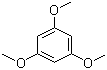
Symmetry can simplify a chemist's work without making a molecule chemically uninteresting. In 1,3,5-trimethoxybenzene, three methoxy groups occupy alternating positions around a benzene ring. The remaining three ring hydrogens are equivalent in the unsubstituted molecule, and the methoxy groups form another equivalent set. That regular arrangement makes the compound useful both as an electron-rich aromatic substrate and, under suitable conditions, as a reference compound in nuclear magnetic resonance measurements.
Its formula is C9H12O3, and its CAS number is 621-23-8. It is the trimethyl ether corresponding to the three phenolic groups of phloroglucinol. Replacing O-H with O-CH3 removes the phenolic hydrogen and changes hydrogen-bond donation and acid-base behavior. The oxygen atoms can still influence the aromatic ring electronically. This comparison shows why an aromatic ether should not be treated as though it were simply a phenol with the same name and a small mass adjustment.
Each methoxy group can donate electron density into the ring through resonance. At the remaining ring positions, the combined substituent pattern favors reaction with suitable electrophiles. For a first substitution, the equivalence of the three positions removes a regioisomer choice that would arise in many less symmetrical aromatic substrates. After substitution, that symmetry is reduced, and later steps can face a different selectivity problem. Symmetry is therefore a useful starting condition rather than a guarantee that every subsequent reaction remains simple.
A documented example of its carbon-carbon bond-forming chemistry appears in a 2013 study of iridium-tin catalysis by Paresh Nath Chatterjee and colleagues. They investigated aza-Friedel-Crafts reactions of N-sulfonyl aldimines with electron-rich aromatic partners, including 1,3,5-trimethoxybenzene. The aromatic ring acts as the carbon nucleophile while the activated imine supplies the electrophilic carbon. The work also explored subsequent transformations leading to triarylmethane frameworks. This is evidence for a defined synthetic role, rather than a claim that the starting aromatic ether itself is a pharmaceutical or a dye.
A different use follows from the uncomplicated proton pattern. In quantitative proton NMR, a known amount of an appropriate reference compound can be compared with a sample through integrated signal areas. The comparison accounts for how many protons contribute to each signal. The supporting material for an Organic Syntheses procedure published in volume 102, page 64, explicitly shows 1,3,5-trimethoxybenzene used as such a reference in a purity determination. Here its value is not the formation of a new bond but a measurable, distinguishable signal.
A useful NMR reference still has to be chosen for the particular experiment. It must dissolve adequately, have known purity, avoid reacting with the sample and provide signals that can be integrated without interference. Relaxation and acquisition conditions also affect quantitative reliability. Calling the compound an internal reference does not mean that it is appropriate for every solvent or every analyte. The simple spectrum makes selection easier, while the measurement method supplies the actual quantitative meaning.
For the starting molecule, the three aromatic protons and nine methoxy protons provide an easily understood integration relationship. Which signal is useful depends on where the sample resonates; simplicity of the reference spectrum helps only when overlap is avoided.
These two roles bring together molecular electronics and measurement. Methoxy substitution activates the ring toward selected transformations, while the regular substitution pattern simplifies recognition of the starting material's signals. The same small aromatic ether can therefore be valuable because it reacts in one experiment and because it remains a well-behaved reference in another.
References:
1. PubChem. 1,3,5-Trimethoxybenzene; CAS 621-23-8. https://pubchem.ncbi.nlm.nih.gov/compound/1_3_5-Trimethoxybenzene
2. Chatterjee PN, Maity AK, Mohapatra SS, Roy S. Heterobimetallic Ir-Sn catalysis: aza-Friedel-Crafts reaction of N-sulfonyl aldimines. Tetrahedron. 2013;69:2816-2826. DOI: 10.1016/j.tet.2013.01.074. https://doi.org/10.1016/j.tet.2013.01.074
3. Rezazadeh S, Conner AM, Watson DA. A General Method for C-Alkylation of Nitroalkanes with Alkyl Halides: Nickel Photoredox Dual-Catalyzed C-Alkylation of Nitroalkanes. Org Synth. 2025;102:64-85. DOI: 10.15227/orgsyn.102.0064. Procedure and supporting NMR material. https://www.orgsyn.org/Content/pdfs/procedures/v102p0064.pdf
|







 GHS07 Warning Details
 chemBlink Chemical Story