
Online Database of Chemicals from Around the World
| Tianjin ComoraTechnology Co., Ltd. | China | |||
|---|---|---|---|---|
 | comoratj.com | |||
 | +86 15908635794 | |||
 | sales@comoratj.com | |||
 | WhatsApp:+86 15908635794 | |||
| Chemical manufacturer since 2026 | ||||
| chemBlink Standard supplier since 2026 | ||||
| Classification | Organic raw materials >> Ketone compound |
|---|---|
| Name | (3aR,6aR)-2,2-dimethyl-2H,3aH,4H,6aH-cyclopenta(d)(1,3)dioxol-4-one |
| Molecular Structure | 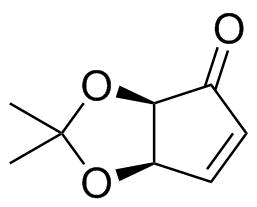 |
| Molecular Formula | C8H10O3 |
| Molecular Weight | 154.16 |
| CAS Registry Number | 115509-13-2 |
| EC Number | 825-377-6 |
| SMILES | CC1(O[C@@H]2C=CC(=O)[C@@H]2O1)C |
| Density | 1.2±0.1 g/cm3 Calc.* |
|---|---|
| Boiling point | 243.8±40.0 °C 760 mmHg (Calc.)* |
| Flash point | 91.7±13.8 °C (Calc.)* |
| Index of refraction | 1.482 (Calc.)* |
| * | Calculated using Advanced Chemistry Development (ACD/Labs) Software. |
| Hazard Symbols |  GHS07 Warning Details | ||||||||||||||||
|---|---|---|---|---|---|---|---|---|---|---|---|---|---|---|---|---|---|
| Risk Statements | H315-H319-H335 Details | ||||||||||||||||
| Safety Statements | P261-P264-P264+P265-P271-P280-P302+P352-P304+P340-P305+P351+P338-P319-P321-P332+P317-P337+P317-P362+P364-P403+P233-P405-P501 Details | ||||||||||||||||
| Hazard Classification | |||||||||||||||||
| |||||||||||||||||
| SDS | Available | ||||||||||||||||
 chemBlink Chemical Story
|
The compound registered as CAS 115509-13-2 is a compact, chiral cyclopentenone whose two neighboring oxygen substituents are joined by an isopropylidene protecting group. Its formula, C8H10O3, and the specified (3aR,6aR) configuration distinguish it from saturated ketones and from the opposite enantiomer. Although systematic names for the fused ring can look cumbersome, the underlying synthetic idea is familiar: preserve a defined arrangement of two oxygen-bearing stereocenters while leaving an unsaturated ketone available for further chemistry. The five-membered carbon ring contains an alkene conjugated with the ketone. This makes it an enone, a functional group with more than one possible reaction site. A reaction at the carbonyl and a conjugate addition to the alkene create different connections. The fused oxygen-containing ring also changes the environment around the two faces of the enone. These structural features explain why a small intermediate can be useful in planning stereochemically complex molecules, but they do not establish the outcome of any particular reaction without experimental evidence. The two methyl groups belong to the acetonide unit. They are not methyl substituents attached independently to the cyclopentenone ring. An acetonide is a cyclic ketal used to protect a neighboring diol; here it ties the two oxygen atoms together. Removal of such a protecting group can reveal the corresponding hydroxyl groups, provided that the rest of the molecule tolerates the chosen conditions. Protection therefore changes when oxygen functionality can participate in a synthesis, rather than eliminating that functionality from the molecular design. A specific application is documented in a 2009 paper by Broggi and colleagues on triazolo-carbanucleosides. The experimental section identifies the optically active enone by CAS 115509-13-2. The researchers used it as an intermediate on the way to a chiral cyclopentane azide, which could then be combined with alkynes to construct triazole-containing products. Here, a simple protected ring serves as a starting platform for a much more elaborate molecular architecture. In a carbocyclic nucleoside analogue, a carbon framework replaces the oxygen-containing sugar ring found in a conventional nucleoside. A suitably oxygenated cyclopentane can help reproduce selected arrangements of substituents without reproducing the complete original sugar structure. The enone is useful at this early stage because it already combines a five-membered carbon ring, protected oxygen functionality, and defined stereochemistry. It is not itself a nucleoside and does not contain a nucleobase. The reported route also illustrates how a functional group can be used temporarily. A vinyl group introduced through conjugate addition provides a precursor for later side-chain elaboration. Subsequent construction leads to an azide-bearing intermediate, and the triazole ring is assembled later by cycloaddition. The original enone therefore contributes to a sequence of transformations rather than remaining unchanged in the final products. Recognizing that sequence gives a much more informative account of a reagent's role than assigning it the biological properties that might be investigated for downstream nucleoside analogues. Research on such analogues still requires separate characterization and biological evaluation of each completed structure. The stereochemical label is equally important. A supplier's identity specification and an ordinary purity measurement answer different questions: the expected mass does not prove the absolute configuration, and a single peak in an achiral chromatogram does not by itself prove enantiomeric purity. For this specialized building block, the defensible story is its combination of a protected diol framework, a reactive enone, and predefined chirality. Specific therapeutic effects or established industrial applications should not be inferred from those features alone. References: 1. Sigma-Aldrich. CAS 115509-13-2: product identity and molecular weight. https://www.sigmaaldrich.com/US/en/search/115509-13-2?focus=products&page=1&perpage=30&sort=relevance&term=115509-13-2&type=cas_number 2. Broggi J et al. Click Azide-Alkyne Cycloaddition for the Synthesis of D-(-)-1,4-Disubstituted Triazolo-Carbanucleosides. Eur J Org Chem. 2009:1880-1888. DOI: 10.1002/ejoc.200801124. https://doi.org/10.1002/ejoc.200801124 3. PubChem. CID 10997245; CAS 115509-13-2. https://pubchem.ncbi.nlm.nih.gov/compound/10997245 |
| Market Analysis Reports |