
Online Database of Chemicals from Around the World
| BOC Sciences | USA | |||
|---|---|---|---|---|
 | www.bocsci.com | |||
 | +1 (631) 485-4226 | |||
 | +1 (631) 614-7828 | |||
 | info@bocsci.com | |||
| Chemical manufacturer | ||||
| chemBlink Standard supplier since 2010 | ||||
| Wuhan Waking Lion Chemicals Co., Ltd. | China | |||
|---|---|---|---|---|
| www.wakinglionphos.com | |||
| +86 (027) 8383-5073 | |||
| +86 (027) 8385-1726 | |||
| tracy@wakinglionphos.com | |||
 | WhatsApp:+8618086649478 | |||
| Chemical manufacturer since 1952 | ||||
| chemBlink Standard supplier since 2026 | ||||
| Achemica | Switzerland | |||
|---|---|---|---|---|
| www.achemica.com | |||
| +41 (24) 466-2929 | |||
| +41 (24) 466-2800 | |||
| contact@achemica.com | |||
| Chemical manufacturer since 2010 | ||||
| Classification | Inorganic chemical industry >> Inorganic salt >> Phosphides, metal phosphoric acid, metaphosphoric acid, hypophosphorous acid and pyrophosphate |
|---|---|
| Name | Diphosphoric acid trisodium salt |
| Synonyms | Trisodium hydrogen diphosphate |
| Molecular Structure | 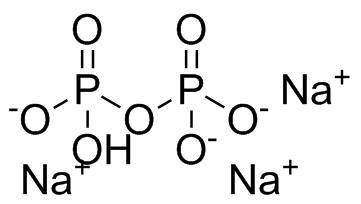 |
| Molecular Formula | Na3HP2O7 |
| Molecular Weight | 243.92 |
| CAS Registry Number | 14691-80-6 |
| EC Number | 238-735-6 |
| SMILES | O=P([O-])([O-])OP(=O)([O-])O.[Na+].[Na+].[Na+] |
| Boiling point | 250 °C (Expl.) |
|---|---|
| Hazard Symbols |   GHS05;GHS07 Danger Details GHS05;GHS07 Danger Details | ||||||||||||
|---|---|---|---|---|---|---|---|---|---|---|---|---|---|
| Risk Statements | H302-H318 Details | ||||||||||||
| Safety Statements | P264-P264+P265-P270-P280-P301+P317-P305+P354+P338-P317-P330-P501 Details | ||||||||||||
| Hazard Classification | |||||||||||||
| |||||||||||||
 chemBlink Chemical Story
|
Trisodium pyrophosphate occupies an interesting middle ground among condensed phosphates. Its composition is Na3HP2O7: a pyrophosphate ion that still retains one acidic hydrogen rather than being fully neutralized to Na4P2O7. JECFA lists it as trisodium diphosphate, acid trisodium pyrophosphate, INS 450(ii), and recognizes both anhydrous and monohydrate forms. The compound is manufactured by heating sodium orthophosphate compositions with the appropriate sodium-to-phosphorus ratio. Heating drives condensation of two phosphate units and creates the P-O-P bond characteristic of pyrophosphate. That one bridge changes the chemistry: pyrophosphate binds metal ions more strongly than simple orthophosphate and can influence protein hydration, mineral precipitation, dispersion, and acid-base behavior. Partial neutralization gives trisodium pyrophosphate a useful property profile. JECFA specifies food uses including stabilizer, leavening agent, emulsifier, and nutrient-related functions. In food processing, condensed phosphates can bind calcium, magnesium, iron, or copper, influence water retention, and modify interactions among proteins and minerals. Health Canada has discussed phosphate functions such as reducing water loss in processed fish, limiting protein denaturation during frozen storage, controlling mineral deposits, and binding metals associated with discoloration. The exact role depends on food and formulation, so the salt should not be treated as one universal additive effect. The word 'acid' in acid trisodium pyrophosphate does not mean it behaves like a strong mineral acid. It means one ionizable hydrogen remains in the pyrophosphate composition. Its aqueous behavior is therefore milder than that of strongly alkaline tetrasodium pyrophosphate. This balance between solubility, metal binding, and near-neutral acid-base behavior is one reason partially neutralized condensed phosphates can be useful in formulations where strongly alkaline conditions would be undesirable. An additional subtlety appears in specifications. Pharmacopeial and food standards may describe trisodium pyrophosphate as an anhydrous salt or monohydrate and, in some contexts, as material functionally equivalent in solution to appropriate mixtures of other sodium pyrophosphates. Such definitions remind us that industrial chemical identity is sometimes operational: what matters is composition, assay, solution behavior, and impurity limits as well as a single structural drawing. Trisodium pyrophosphate is memorable because it shows how partial neutralization can be a design tool. The same P2O7 skeleton can be paired with different numbers of sodium ions and protons to tune pH, solubility, and functionality. In food and process chemistry, the difference between three sodium ions and four can determine whether a condensed phosphate fits the formulation. References: 1. FAO/WHO JECFA. Trisodium diphosphate, INS 450(ii), specifications from the 69th meeting, 2008. 2. USP/Food Chemicals Codex. Trisodium Pyrophosphate. DOI: 10.31003/FCC_F103520_05_01. 3. Health Canada assessments and permitted-use information for phosphate food additives. 4. General condensed-phosphate literature on metal sequestration, water retention, and protein interactions. |
| Market Analysis Reports |