
Online Database of Chemicals from Around the World
| Hangzhou Verychem Science And Technology Co., Ltd. | China | |||
|---|---|---|---|---|
 | www.verychem.com | |||
 | +86 (571) 8816-2785 +86 13606544505 | |||
 | +86 (571) 8816-2787 | |||
 | lucy@verychem.com | |||
| Chemical manufacturer since 2004 | ||||
| chemBlink Massive supplier since 2021 | ||||
| BeLang Pharma Co., Ltd. | China | |||
|---|---|---|---|---|
| www.belangpharma.com | |||
| +86 13885682355 | |||
| info@belangpharma.com | |||
 | QQ Chat | |||
| Chemical manufacturer since 2019 | ||||
| chemBlink Standard supplier since 2019 | ||||
| Classification | Organic raw materials >> Amino compound >> Amide compound |
|---|---|
| Name | Exatecan Intermediate 2 |
| Synonyms | N-(8-Amino-6-fluoro-5-methyl-1-oxo-1,2,3,4-tetrahydronaphthalen-2-yl)acetamide |
| Molecular Structure | 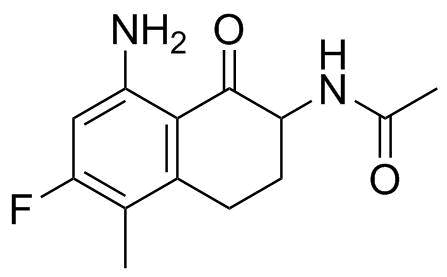 |
| Molecular Formula | C13H15FN2O2 |
| Molecular Weight | 250.27 |
| CAS Registry Number | 182182-31-6 |
| SMILES | CC1=C(C=C(C2=C1CCC(C2=O)NC(=O)C)N)F |
| Density | 1.3±0.1 g/cm3 Calc.* |
|---|---|
| Boiling point | 550.1±50.0 °C 760 mmHg (Calc.)* |
| Flash point | 286.5±30.1 °C (Calc.)* |
| Index of refraction | 1.575 (Calc.)* |
| * | Calculated using Advanced Chemistry Development (ACD/Labs) Software. |
| Hazard Symbols |  GHS07 Warning Details GHS07 Warning Details |
|---|---|
| Risk Statements | H302-H315-H319 Details |
| Safety Statements | P501-P270-P264-P280-P302+P352-P337+P313-P305+P351+P338-P362+P364-P332+P313-P301+P312+P330 Details |
| SDS | Available |
 chemBlink Chemical Story
|
Some pharmaceutical intermediates become interesting only when their place in a larger molecular story is recognized. Exatecan Intermediate 2, CAS 182182-31-6, is N-(8-amino-6-fluoro-5-methyl-1-oxo-1,2,3,4-tetrahydronaphthalen-2-yl)acetamide, a fluorinated tetralone derivative used in synthetic routes toward exatecan-related chemistry. Exatecan belongs to the camptothecin family of topoisomerase I inhibitors. Camptothecin itself is a natural-product scaffold whose fused ring system can trap the transient DNA-topoisomerase I cleavage complex. When the enzyme attempts to relieve torsional stress in DNA, camptothecin-type inhibitors stabilize an otherwise short-lived covalent intermediate; collisions with replication machinery then turn this trapped state into DNA damage. Exatecan was developed as a potent, more soluble camptothecin analog, but as a freely administered cytotoxic drug its therapeutic window was limited. The later importance of exatecan chemistry came from a different strategy: do not simply make the poison stronger - deliver a related payload more selectively. Daiichi Sankyo researchers developed DXd, or deruxtecan, as an exatecan-derived topoisomerase I inhibitor suitable for antibody-drug conjugates. In an ADC, an antibody recognizes a tumor-associated target while a linker carries a highly potent small-molecule payload. This design helped make exatecan-derived chemistry central to modern oncology. Trastuzumab deruxtecan and datopotamab deruxtecan are examples of approved ADCs using DXd-class payload technology. That history gives an otherwise obscure intermediate a more memorable identity. The amino, fluoro, methyl, ketone, and acetamide functions in Exatecan Intermediate 2 are not there because the compound itself is intended to be a drug. They are part of a staged construction of a much more elaborate polycyclic pharmacophore. Process chemists need intermediates such as this to introduce the correct substitution pattern before later ring-forming, stereochemical, and functional-group transformations. The molecule therefore illustrates an important feature of pharmaceutical manufacturing: a clinically important drug technology may depend on compounds that never appear on a medicine label. Their value is architectural. Exatecan Intermediate 2 is one of the pieces used to reach a family of topoisomerase I payloads whose significance expanded dramatically when potent cytotoxic chemistry was combined with targeted antibody delivery. References: 1. PubChem, N-(8-Amino-6-fluoro-5-methyl-1-oxo-1,2,3,4-tetrahydronaphthalen-2-yl)acetamide, CID 10220585. 2. Ogitani Y. et al. Bioorg Med Chem Lett. 2016, 26, 5069-5072. DOI: 10.1016/j.bmcl.2016.08.082. 3. Conilh L. et al. Pharmaceuticals. 2021, 14, 247. PMCID: PMC8000490. 4. Payload-Based Clinical Pharmacology Review of Approved Antibody-Drug Conjugates. Clin Pharmacol Ther. 2026. |
| Market Analysis Reports |