
Online Database of Chemicals from Around the World
| Hangzhou Verychem Science And Technology Co., Ltd. | China | |||
|---|---|---|---|---|
 | www.verychem.com | |||
 | +86 (571) 8816-2785 +86 13606544505 | |||
 | +86 (571) 8816-2787 | |||
 | lucy@verychem.com | |||
| Chemical manufacturer since 2004 | ||||
| chemBlink Massive supplier since 2021 | ||||
| Nanjing Finetech Chemical Co., Ltd. | China | |||
|---|---|---|---|---|
| www.fine-chemtech.com | |||
| +86 (25) 5207-8417 +86 17714198479 | |||
| +86 (25) 5207-8417 | |||
| sales@fine-chemtech.com | |||
 | QQ Chat | |||
| Chemical manufacturer since 2007 | ||||
| chemBlink Standard supplier since 2007 | ||||
| Shanghai Pansopharm Technology Co., Ltd. | China | |||
|---|---|---|---|---|
| www.pansopharm.com | |||
| +86 (21) 2096-2833 +86 15618308650 | |||
| +86 (21) 2096-2832 | |||
| sales@pansopharm.com | |||
| QQ Chat | |||
| Chemical manufacturer since 2012 | ||||
| chemBlink Standard supplier since 2013 | ||||
| Classification | Organic raw materials >> Alcohols, phenols, phenolic compounds and derivatives |
|---|---|
| Name | (2R,7aS)-2-fluorotetrahydro-1H-Pyrrolizine-7a(5H)-methanol |
| Synonyms | [(2R,8S)-2-fluoro-1,2,3,5,6,7-hexahydropyrrolizin-8-yl]methanol |
| Molecular Structure | 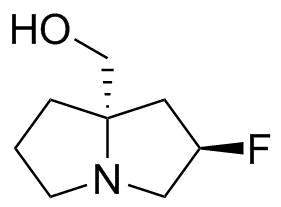 |
| Molecular Formula | C8H14FNO |
| Molecular Weight | 159.20 |
| CAS Registry Number | 2097518-76-6 |
| EC Number | 882-537-8 |
| SMILES | C1C[C@]2(C[C@H](CN2C1)F)CO |
| Solubility | Very Soluble (205 g/L) (25 °C), Calc.* |
|---|---|
| Density | 1.2±0.1 g/cm3 Calc.* |
| Boiling point | 225.6±15.0 °C 760 mmHg (Calc.)* |
| Flash point | 90.2±20.4 °C (Calc.)* |
| Index of refraction | 1.517 (Calc.)* |
| * | Calculated using Advanced Chemistry Development (ACD/Labs) Software V11.02 (©1994-2021 ACD/Labs) |
| Hazard Symbols |  GHS07 Warning Details GHS07 Warning Details |
|---|---|
| Risk Statements | H302-H315-H319-H335 Details |
| Safety Statements | P261-P264-P264+P265-P270-P271-P280-P301+P317-P302+P352-P304+P340-P305+P351+P338-P319-P321-P330-P332+P317-P337+P317-P362+P364-P403+P233-P405-P501 Details |
| SDS | Available |
 chemBlink Chemical Story
|
Why would medicinal chemists care about a small bicyclic amino alcohol with a fluorine atom? CAS 2097518-76-6, ((2R,7aS)-2-fluorotetrahydro-1H-pyrrolizin-7a(5H)-yl)methanol, has become notable because this compact chiral framework appears in the chemistry of inhibitors directed at KRAS G12D, one of the most important oncogenic mutations. KRAS is a molecular switch that cycles between GDP- and GTP-bound states and helps control cell-growth signaling. Mutations can lock the pathway into abnormal signaling. For many years KRAS was regarded as exceptionally difficult to drug because its surface offered few obvious small-molecule pockets and because the protein binds guanine nucleotides very tightly. The success of covalent KRAS G12C inhibitors changed that perception, but G12D presents a different chemical problem: aspartate replaces glycine at position 12, so the reactive cysteine exploited by G12C drugs is absent. Recent KRAS G12D programs therefore rely on different binding strategies and carefully shaped three-dimensional molecules. This is where the fluorinated pyrrolizine alcohol becomes interesting. Its fused bicyclic amine constrains the molecule into a defined shape rather than allowing a flexible chain to explore many conformations. The stereochemistry fixes the spatial relationship between the nitrogen, fluorinated carbon, and hydroxymethyl group. Medicinal chemists can then use the alcohol as a point for further attachment while the bicyclic core occupies a precisely defined region of a larger inhibitor. The fluorine atom is also purposeful. Carbon-fluorine substitution can influence local conformation, polarity, basicity of nearby amines, metabolic stability, and protein binding. In a rigid chiral scaffold, even a single fluorine may change how the entire fragment presents itself to a target. The result is a small building block carrying unusually dense three-dimensional information. Its synthesis is correspondingly demanding. Published patent work on scalable preparation emphasizes stereochemical control and construction of the fused pyrrolizine core, reflecting a common challenge in modern medicinal chemistry: once a three-dimensional fragment proves valuable, the discovery route must be converted into a practical manufacturing route with high enantiomeric purity. This compound therefore tells a broader story about drug design after the era of flat aromatic fragments. Modern oncology increasingly depends on rigid, stereodefined building blocks that position functional groups with molecular precision. CAS 2097518-76-6 is memorable not because it is an inhibitor by itself, but because its "butterfly-shaped" chiral scaffold helps chemists build molecules aimed at a mutation that was once considered extremely difficult to target. References: 1. PubChem, ((2R,7aS)-2-Fluorotetrahydro-1H-pyrrolizin-7a(5H)-yl)methanol, CID 118109097. 2. WO2024092420A1, Preparation method for ((2R,7aS)-2-fluorohexahydro-1H-pyrrolizin-7a-yl)methanol. 3. MedChemExpress, CAS 2097518-76-6, KRAS G12D inhibitor building block. |
| Market Analysis Reports |