
Online Database of Chemicals from Around the World
| Shanghai Suifu Chemical Technology Co., Ltd. | China | |||
|---|---|---|---|---|
 | www.suifuhuagong.com | |||
 | +86 (21) 3373-8187 +86 19945655289 | |||
 | +86 (21) 3373-8187 | |||
 | suifuchemical@163.com | |||
 | QQ Chat | |||
 | Skype Chat | |||
| Chemical manufacturer since 2017 | ||||
| chemBlink Standard supplier since 2019 | ||||
| Tianjin ComoraTechnology Co., Ltd. | China | |||
|---|---|---|---|---|
| comoratj.com | |||
| +86 15908635794 | |||
| sales@comoratj.com | |||
 | WhatsApp:+86 15908635794 | |||
| Chemical manufacturer since 2026 | ||||
| chemBlink Standard supplier since 2026 | ||||
| Classification | Chemical reagent >> Chiral chemical reagent |
|---|---|
| Name | (1R)-2,2',3,3'-Tetrahydro-1,1'-spirobi[1H-indene]-7,7'-diol |
| Synonyms | (R)-SPINOL; (R)-1,1'-Spirobiindane-7,7'-diol |
| Molecular Structure | 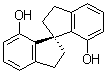 |
| Molecular Formula | C17H16O2 |
| Molecular Weight | 252.31 |
| CAS Registry Number | 223259-62-9 |
| SMILES | C1CC2(CCC3=C2C(=CC=C3)O)C4=C1C=CC=C4O |
| Solubility | Practically insoluble (0.038 g/L) (25 °C), Calc.* |
|---|---|
| Density | 1.34±0.1 g/cm3 (20 °C 760 Torr), Calc.* |
| Melting point | 158-159 °C (hexane )** |
| Boiling point | 433.0±45.0 °C 760 mmHg (Calc.)* |
| Flash point | 208.9±23.3 °C (Calc.)* |
| Index of refraction | 1.71 (Calc.)* |
| * | Calculated using Advanced Chemistry Development (ACD/Labs) Software V11.02 (©1994-2019 ACD/Labs) |
| ** | Li, Zhian |
| Hazard Symbols |  GHS07 Warning Details |
|---|---|
| Risk Statements | H302-H315-H319-H335 Details |
| Safety Statements | P261-P280-P301+P312-P302+P352-P305+P351+P338 Details |
| SDS | Available |
 chemBlink Chemical Story
|
The R in (R)-SPINOL carries information that a molecular formula cannot supply. CAS 223259-62-9 identifies the R enantiomer of 1,1'-spirobiindane-7,7'-diol, a rigid diol used as a starting framework in chiral chemistry. Its mirror-image partner has the same atoms and the same connections, but a different three-dimensional arrangement. That difference becomes consequential when the molecule is incorporated into a stereochemically selective system. SPINOL contains two indane units joined at a shared spiro carbon. The phenolic hydroxyl groups provide points for derivatization, while the ring system restricts the arrangement of the resulting structure. In catalyst development, such a framework can help position functional groups around a reaction site. The useful feature is not simply the presence of two oxygen atoms, but their relationship to the surrounding three-dimensional backbone. The framework entered the literature through the 1999 work of Birman, Rheingold, and Lam, which included preparation and resolution of the diol. This history explains why access to a single enantiomer is a separate achievement from access to the carbon skeleton. A synthesis that gives racemic SPINOL has created the framework, but has not by itself supplied the R form with a specified enantiomeric purity. For the R product, identity and analytical specification therefore answer different questions. The CAS number and structural name indicate the intended enantiomer. Chemical purity describes the amount of unrelated material, while enantiomeric purity describes the relative abundance of the two mirror-image forms. One number cannot substitute for the other. Supplier data and an appropriate chiral analysis must be interpreted in terms of the property actually measured. The same care applies when reading a catalytic result. A ligand or phosphoric acid derived from SPINOL is a new chemical structure, and its substituents, metal partner where applicable, substrate, and conditions all influence performance. Nor does an R label on the starting diol automatically mean that a final reaction product will have R configuration. Those descriptors belong to different molecular structures and require their own assignments. The value of (R)-SPINOL is that it supplies a defined handed framework from which researchers can build and compare chiral environments. It turns stereochemistry into a controlled design choice, while leaving activity and selectivity to be established for each actual derivative and reaction. References: 1. TCI. (R)-1,1'-Spirobiindane-7,7'-diol, CAS 223259-62-9; product S0957. https://www.tcichemicals.com/US/en/p/S0957 2. Birman VB, Rheingold AL, Lam KC. 1,1'-Spirobiindane-7,7'-diol: a novel, C2-symmetric chiral ligand. Tetrahedron: Asymmetry. 1999;10:125-131. https://doi.org/10.1016/S0957-4166(98)00481-9 |
| Market Analysis Reports |