
Online Database of Chemicals from Around the World
| BOC Sciences | USA | |||
|---|---|---|---|---|
 | www.bocsci.com | |||
 | +1 (631) 485-4226 | |||
 | +1 (631) 614-7828 | |||
 | info@bocsci.com | |||
| Chemical manufacturer | ||||
| chemBlink Standard supplier since 2010 | ||||
| Alfa Chemistry | USA | |||
|---|---|---|---|---|
| www.alfa-chemistry.com | |||
| +1 (516) 734-6573 | |||
| +1 (516) 927-0118 | |||
| support@alfa-chemistry.com | |||
| Chemical manufacturer since 2005 | ||||
| chemBlink Standard supplier since 2012 | ||||
| Shanghai Suifu Chemical Technology Co., Ltd. | China | |||
|---|---|---|---|---|
| www.suifuhuagong.com | |||
| +86 (21) 3373-8187 +86 19945655289 | |||
| +86 (21) 3373-8187 | |||
| suifuchemical@163.com | |||
 | QQ Chat | |||
 | Skype Chat | |||
| Chemical manufacturer since 2017 | ||||
| chemBlink Standard supplier since 2019 | ||||
| Tianjin ComoraTechnology Co., Ltd. | China | |||
|---|---|---|---|---|
| comoratj.com | |||
| +86 15908635794 | |||
| sales@comoratj.com | |||
 | WhatsApp:+86 15908635794 | |||
| Chemical manufacturer since 2026 | ||||
| chemBlink Standard supplier since 2026 | ||||
| Classification | Chemical reagent >> Chiral chemical reagent |
|---|---|
| Name | (1S)-2,2',3,3'-Tetrahydro-1,1'-spirobi[1H-indene]-7,7'-diol |
| Synonyms | 3,3'-spirobi[1,2-dihydroindene]-4,4'-diol |
| Molecular Structure | 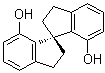 |
| Molecular Formula | C17H16O2 |
| Molecular Weight | 252.31 |
| CAS Registry Number | 223259-63-0 |
| SMILES | C1CC2(CCC3=C2C(=CC=C3)O)C4=C1C=CC=C4O |
| Solubility | Practically insoluble (0.038 g/L) (25 °C), Calc.* |
|---|---|
| Density | 1.34±0.1 g/cm3 (20 °C 760 Torr), Calc.* |
| Melting point | 155-156 °C** |
| Boiling point | 433.0±45.0 °C 760 mmHg (Calc.)* |
| Flash point | 208.9±23.3 °C (Calc.)* |
| Index of refraction | 1.71 (Calc.)* |
| * | Calculated using Advanced Chemistry Development (ACD/Labs) Software V11.02 (©1994-2014 ACD/Labs) |
| ** | Li, Zhian |
| Hazard Symbols |  GHS07 Warning Details |
|---|---|
| Risk Statements | H302-H315-H319-H335 Details |
| Safety Statements | P261-P280-P301+P312-P302+P352-P305+P351+P338 Details |
| SDS | Available |
 chemBlink Chemical Story
|
A chiral catalyst needs more than a reactive group: it needs a surrounding shape that can distinguish two possible spatial approaches. (S)-SPINOL, CAS 223259-63-0, provides a framework from which such environments can be constructed. The compound is the S enantiomer of 1,1'-spirobiindane-7,7'-diol. Two phenolic hydroxyl groups are held within a rigid spirocyclic structure, giving chemists a defined starting geometry for further modification. The term spiro describes the shared atom connecting the two ring systems. Here that arrangement supports a handed molecular framework. The S descriptor distinguishes this entry from the R enantiomer and from SPINOL entries without a specified configuration. It does not indicate a concentration, a purity grade, or the sign of optical rotation. Those are separate pieces of information that require their own measurements or descriptions. A direct application of the S starting material was reported in 2010 in the Journal of Organic Chemistry. Researchers prepared a series of SPINOL-derived chiral phosphoric acids and applied them to Friedel-Crafts reactions between indoles and imines. The resulting carbon-carbon bond formation furnished chiral indolylmethanamine products. This is a documented example of turning the S diol into a catalytic architecture rather than merely listing it as a generic reagent. The transformation from diol to phosphoric acid changes the molecule's functional role. The starting phenolic groups become part of a different phosphorus-containing arrangement, and additional substituents help define the space around the acidic site. The framework contributes organization, while the completed derivative supplies the particular catalytic environment. Describing this distinction avoids attributing the reported catalytic behavior directly to unmodified (S)-SPINOL. For asymmetric synthesis, the objective is to favor one enantiomer of a product over the other. The balance is a property of the whole reaction system. Even when the starting framework has a fixed configuration, changing a substrate or a catalyst substituent can change the outcome. A successful literature example is evidence for that example, not a promise of the same selectivity across unrelated reactions. The story of (S)-SPINOL therefore illustrates how a small, well-defined building block can become part of a sophisticated molecular environment. Its value lies in giving researchers a reproducible stereochemical starting point from which to explore catalyst structure, reaction behavior, and the relationship between molecular shape and selectivity. References: 1. TCI. (S)-1,1'-Spirobiindane-7,7'-diol, CAS 223259-63-0; product S0958. https://www.tcichemicals.com/IN/en/p/S0958 2. SPINOL-Derived Phosphoric Acids: Synthesis and Application in Enantioselective Friedel-Crafts Reaction of Indoles with Imines. J Org Chem. 2010;75:8677-8680. https://doi.org/10.1021/jo101640z 3. Birman VB, Rheingold AL, Lam KC. 1,1'-Spirobiindane-7,7'-diol: a novel, C2-symmetric chiral ligand. Tetrahedron: Asymmetry. 1999;10:125-131. https://doi.org/10.1016/S0957-4166(98)00481-9 |
| Market Analysis Reports |