
Online Database of Chemicals from Around the World
| Labseeker Inc | USA | |||
|---|---|---|---|---|
 | www.labseeker.com | |||
 | +1 (858) 750-1632 | |||
 | +1 (858) 412-1220 | |||
 | marketing@labseeker.com | |||
| Chemical manufacturer since 2002 | ||||
| chemBlink Standard supplier since 2015 | ||||
| Hangzhou Leap Chem Co., Ltd. | China | |||
|---|---|---|---|---|
| www.leapchem.com | |||
| +86 (571) 8771-1850 | |||
| market19@leapchem.com | |||
 | QQ Chat | |||
| Chemical manufacturer since 2006 | ||||
| chemBlink Standard supplier since 2015 | ||||
| Amadis Chemical Co., Ltd. | China | |||
|---|---|---|---|---|
| www.amadischem.com | |||
| +86 (571) 8992-5085 | |||
| +86 (571) 8992-5065 | |||
| sales@amadischem.com | |||
| Chemical manufacturer since 2010 | ||||
| chemBlink Standard supplier since 2015 | ||||
| Shanghai Fuxin Pharmaceutical Co., Ltd. | China | |||
|---|---|---|---|---|
| www.fuxinpharm.com | |||
| +86 (21) 3130-0828 +86 18645121291 | |||
| +86 (21) 3130-0828 | |||
| contact@fuxinpharm.com | |||
| Chemical manufacturer since 2016 | ||||
| chemBlink Standard supplier since 2018 | ||||
| Tianjin ComoraTechnology Co., Ltd. | China | |||
|---|---|---|---|---|
| comoratj.com | |||
| +86 15908635794 | |||
| sales@comoratj.com | |||
 | WhatsApp:+86 15908635794 | |||
| Chemical manufacturer since 2026 | ||||
| chemBlink Standard supplier since 2026 | ||||
| Organix Inc. | USA | |||
|---|---|---|---|---|
| www.organixinc.com | |||
| +1 (781) 932-4142 | |||
| +1 (781) 933-6695 | |||
| mahadevan@organixinc.com blundell@organixinc.com | |||
| Chemical manufacturer since 1986 | ||||
| Classification | Organic raw materials >> Organic phosphine compound |
|---|---|
| Name | (Aminooxy)diphenylphosphine oxide |
| Synonyms | O-Diphenylphosphinylhydroxylamine |
| Molecular Structure | 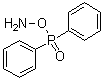 |
| Molecular Formula | C12H12NO2P |
| Molecular Weight | 233.20 |
| CAS Registry Number | 72804-96-7 |
| EC Number | 810-371-8 |
| SMILES | C1=CC=C(C=C1)P(=O)(C2=CC=CC=C2)ON |
| Solubility | Slightly soluble (2.1 g/L) (25 °C), Calc.* |
|---|---|
| Density | 1.25±0.1 g/cm3 (20 °C 760 Torr), Calc.* |
| Melting point | >140 °C (decomp)** |
| Boiling point | 368.0±25.0 °C 760 mmHg (Calc.)* |
| Flash point | 176.3±23.2 °C (Calc.)* |
| Index of refraction | 1.597 (Calc.)* |
| * | Calculated using Advanced Chemistry Development (ACD/Labs) Software V11.02 (©1994-2014 ACD/Labs) |
| ** | Kloetzer, Wilhelm |
| Hazard Symbols |  GHS07 Warning Details | ||||||||||||||||||||
|---|---|---|---|---|---|---|---|---|---|---|---|---|---|---|---|---|---|---|---|---|---|
| Risk Statements | H312-H315-H319-H335 Details | ||||||||||||||||||||
| Safety Statements | P261-P264-P264+P265-P271-P280-P302+P352-P304+P340-P305+P351+P338-P317-P319-P321-P332+P317-P337+P317-P362+P364-P403+P233-P405-P501 Details | ||||||||||||||||||||
| Hazard Classification | |||||||||||||||||||||
| |||||||||||||||||||||
| SDS | Available | ||||||||||||||||||||
 chemBlink Chemical Story
|
Nitrogen is often introduced into an organic molecule by allowing an amine to attack an electrophilic carbon. O-(Diphenylphosphinyl)hydroxylamine offers the reverse perspective: it can act as an electrophilic nitrogen source. Registered as CAS 72804-96-7, this reagent contains an amino group connected through oxygen to a diphenylphosphinyl unit. The connectivity helps make nitrogen transfer possible in reactions with suitable nucleophiles. The compound is frequently abbreviated DPPH in synthetic literature. That abbreviation must be interpreted with care because DPPH is also widely used for the unrelated diphenylpicrylhydrazyl radical in antioxidant assays. The shared letters do not imply a shared structure, mechanism, or purpose. The full reagent name and CAS number are essential when moving between these different areas of chemistry. Early work reported the hydroxylamine derivative as a reagent for electrophilic amination. Depending on the substrate and method, nitrogen transfer can create a carbon-nitrogen bond or introduce a new nitrogen onto an existing nitrogen-containing group. The useful conceptual feature is a change in reaction polarity: the nitrogen source accepts a bond-forming interaction from a suitable nucleophilic partner, rather than behaving like an ordinary nucleophilic amine. A more recent, independently checked example appears in Organic Syntheses in 2026. The procedure uses this reagent to convert an arylboronic acid into an aniline derivative. This application links a familiar carbon-boron building block with a direct route to a carbon-nitrogen product. The detailed functional-group compatibility belongs to the demonstrated method rather than to an unrestricted claim that every boronic acid will react identically. An especially different application was reported in Nature Synthesis in 2024: carbon-carbon bond formation through nitrogen deletion from secondary amines. Here the reagent participates in a strategy that ultimately removes nitrogen from a molecular framework while connecting carbon fragments. The outcome is distinct from simply installing an amino group, even though nitrogen-related activation is central to the chemistry. The contrast is instructive. A reagent can be classified by a characteristic mode of reactivity without being confined to one net transformation. Introducing nitrogen at one stage can help enable its later removal in another sequence. Understanding what the reagent first activates and what the overall process finally produces are separate parts of reading a reaction correctly. These applications place the compound at the intersection of functional-group installation and skeletal editing. Its role is synthetic, not that of a biological probe inferred from the antioxidant meaning of the same abbreviation. Exact identity prevents that confusion; attention to the actual substrate and sequence prevents overgeneralizing a successful example. The phosphorus-containing portion should also be identified precisely. Two phenyl groups are attached to phosphorus, and the hydroxylamine-derived unit is connected through oxygen. This is not a bottle of hydroxylamine mixed with an unrelated phosphorus additive. The covalent arrangement creates the particular reagent, and changing that arrangement would require its own evidence about reactivity. In the arylboronic-acid example, the carbon framework already exists before amination. The transformation changes the functional connection at a selected carbon rather than constructing the entire aromatic ring. That makes the reaction useful to discuss as a change in molecular functionality, while the secondary-amine nitrogen-deletion example goes further and changes how carbon fragments are connected within the framework. The broader story is that reaction polarity and reaction outcome are related but not identical. A defined nitrogen-transfer reagent can help chemists make amino compounds, modify nitrogen centers, or redesign a carbon framework through a more elaborate sequence. The value lies in the experimentally established chemistry connecting the starting structure to the intended product. References: 1. Colvin EW, Kirby GW, Wilson AC. (Diphenylphosphinyl)hydroxylamine: A New Reagent for Electrophilic Amination. Tetrahedron Lett. 1982;23:3835-3836. https://doi.org/10.1016/S0040-4039(00)87720-5 2. Leung KH, Liu RY. Amination of Aryl Boronic Acids Using O-(Diphenylphosphinyl)hydroxylamine (DPPH). Org Synth. 2026;103:64-77. https://doi.org/10.15227/orgsyn.103.0064 3. Guo T et al. C(sp3)-C(sp3) bond formation through nitrogen deletion of secondary amines using O-diphenylphosphinylhydroxylamine. Nat Synth. 2024. https://doi.org/10.1038/s44160-024-00559-9 |
| Market Analysis Reports |